
 中文简体
中文简体
 English




postmaster@goobagelfood.com
Content
- 1 1. Product Overview
- 2 2. A Layered Sensory Experience
- 3 3. Advantages Over Conventional and Competing Bagels
- 4 4. Manufacturing Strengths Behind the Product
- 5 5. Applications for Retail, Foodservice, and Café Operators
- 6 6. Product Positioning and Marketing Opportunities
- 7 7. Quality and Supply Considerations for Buyers
- 8 8. Why a Specialized Manufacturing Partner Matters
- 9 9. Product Development Potential
- 10 10. Serving Suggestions
- 11 11. Frequently Asked Questions
- 11.1 Q1: What type of product is the toasted almond mango-coconut bagel?
- 11.2 Q2: What is the stated product weight?
- 11.3 Q3: What does the product taste like?
- 11.4 Q4: What texture can consumers expect?
- 11.5 Q5: Is the product suitable for cafés?
- 11.6 Q6: Can the product be used by retail and foodservice buyers?
- 11.7 Q7: What are the product’s main advantages over a plain bagel?
- 11.8 Q8: What are the main allergen considerations?
- 11.9 Q9: Why is frozen production useful for commercial customers?
- 11.10 Q10: What manufacturing experience does the supplier have?
- 11.11 Q11: How many bagel varieties has the company developed?
- 11.12 Q12: Can buyers request OEM or private-label cooperation?
- 11.13 Q13: How should the bagel be prepared?
- 11.14 Q14: What makes the almond topping commercially valuable?
- 11.15 Q15: Is the product only suitable for summer?
- 12 12. Conclusion
- 13 References
- 14 Product: Toasted Almond Mango-Coconut Bagel
The toasted almond mango-coconut bagel combines tropical fruit character, creamy dairy richness, and a refined nutty topping in one convenient bakery format. Designed for consumers who want something more distinctive than a plain or traditional savory bagel, this 78g fruit bagel delivers a layered eating experience that moves from crisp and aromatic to soft, creamy, bright, and pleasantly sweet.
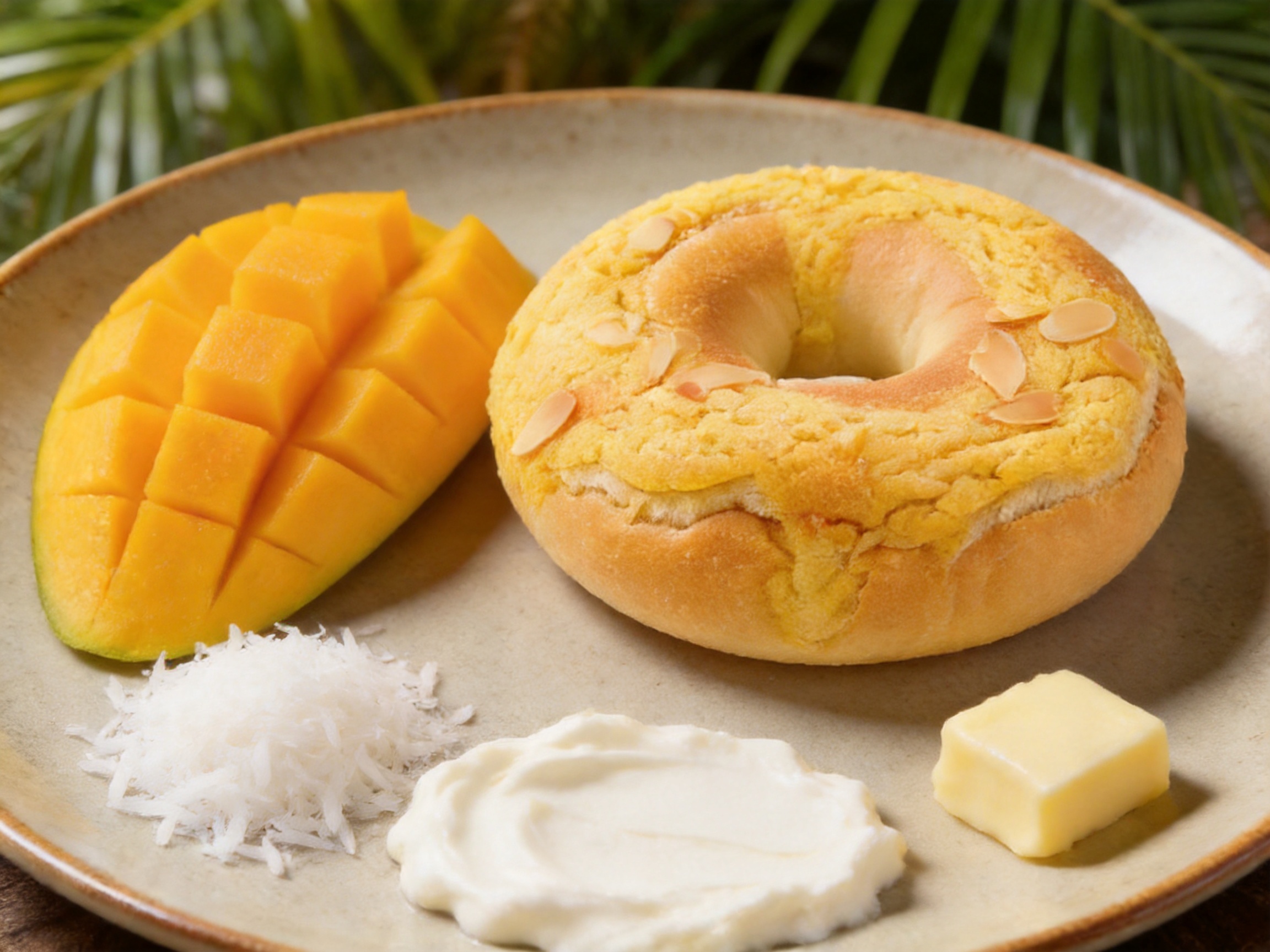
At a time when bakery customers are looking for more variety, clean-label positioning, attractive presentation, and convenient frozen products, specialty bagels have become an increasingly useful product category. The toasted almond mango-coconut bagel answers this demand with an unusual but approachable flavor combination. Mango contributes a vivid fruit note and gentle sweet-tart lift. Coconut adds a silky tropical fragrance. Toasted almond flakes supply a delicate crunch and warm roasted aroma. Anchor cream cheese and real dairy butter provide body, smoothness, and a comforting milky finish.
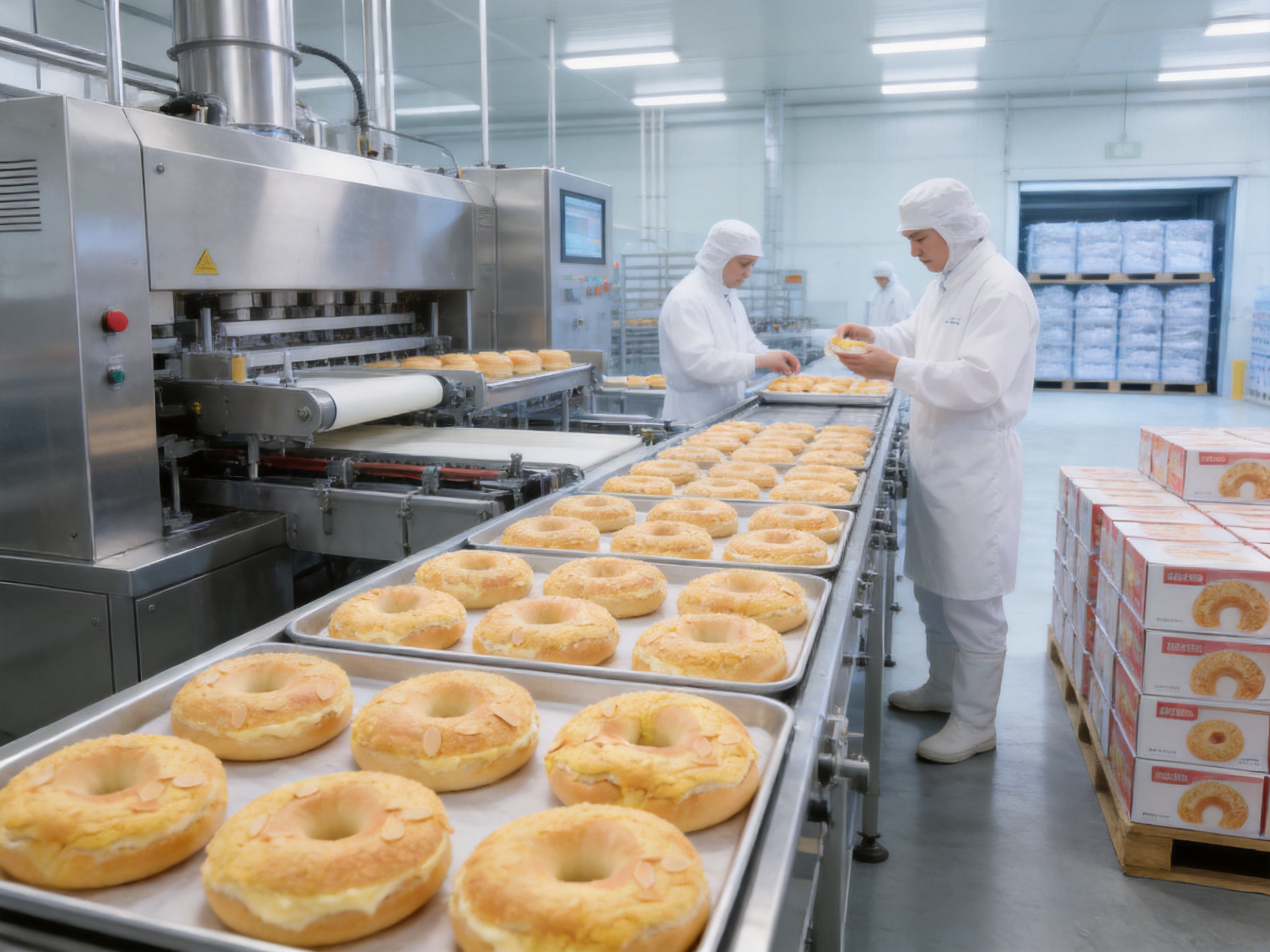
Beyond its flavor profile, the product is supported by the manufacturing capabilities of Jiangsu Goobagel Food Technology Co., Ltd., a modern frozen bakery producer specializing in bagel research and manufacturing since 2019. The company operates an integrated supply chain that connects raw materials, research and development, production, and distribution. This structure allows the business to develop a broad range of bagel products while maintaining consistency for retail, foodservice, cafés, tea brands, bakery operators, and private-label customers.
The result is more than a flavored bagel. It is a commercially practical bakery solution that combines product differentiation with frozen supply-chain convenience. Its format can support breakfast menus, café displays, afternoon snacks, bakery assortments, dessert-inspired promotions, and seasonal tropical campaigns.
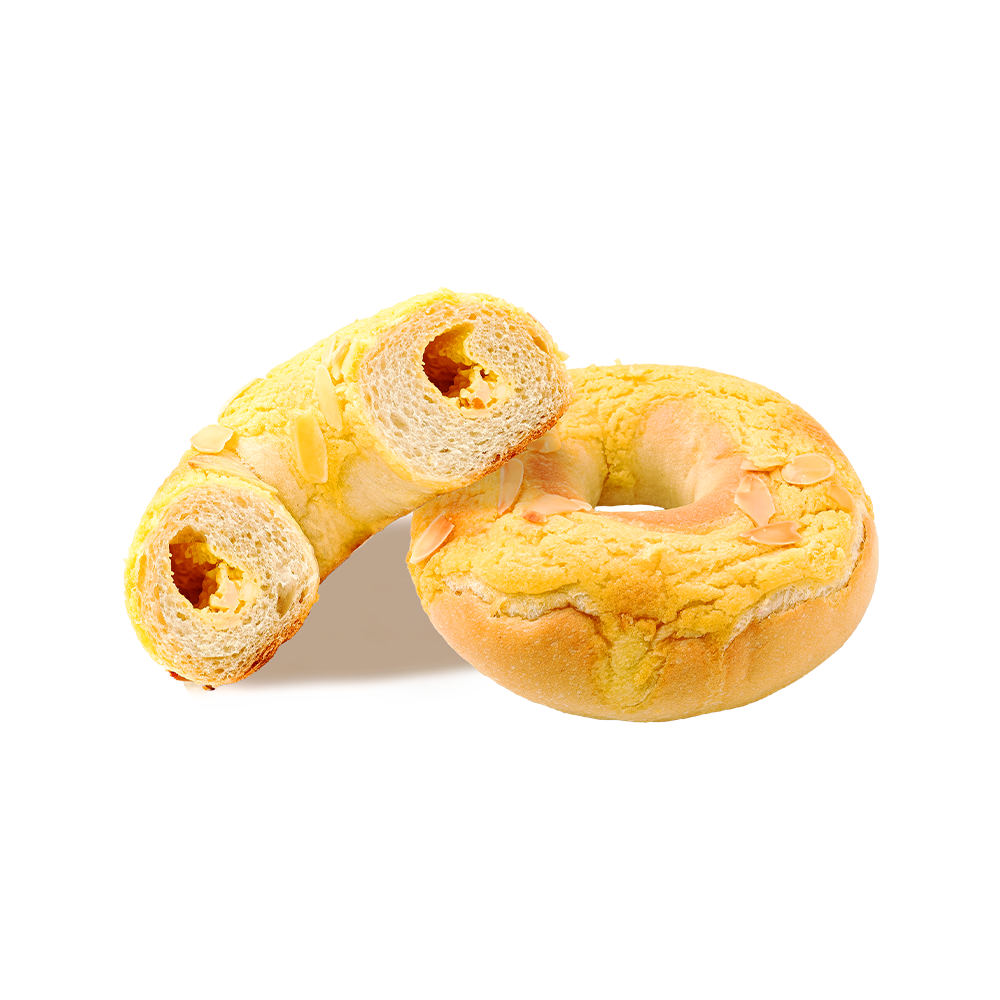
Toasted Almond Mango-Coconut Bagel
1. Product Overview
The toasted almond mango-coconut bagel belongs to the Fruits Bagel category. It has a stated product weight of 78g, making it a practical single-serving size for breakfast, snack occasions, and foodservice menu applications. The product is built around a classic bagel structure while introducing a more dessert-like flavor direction.
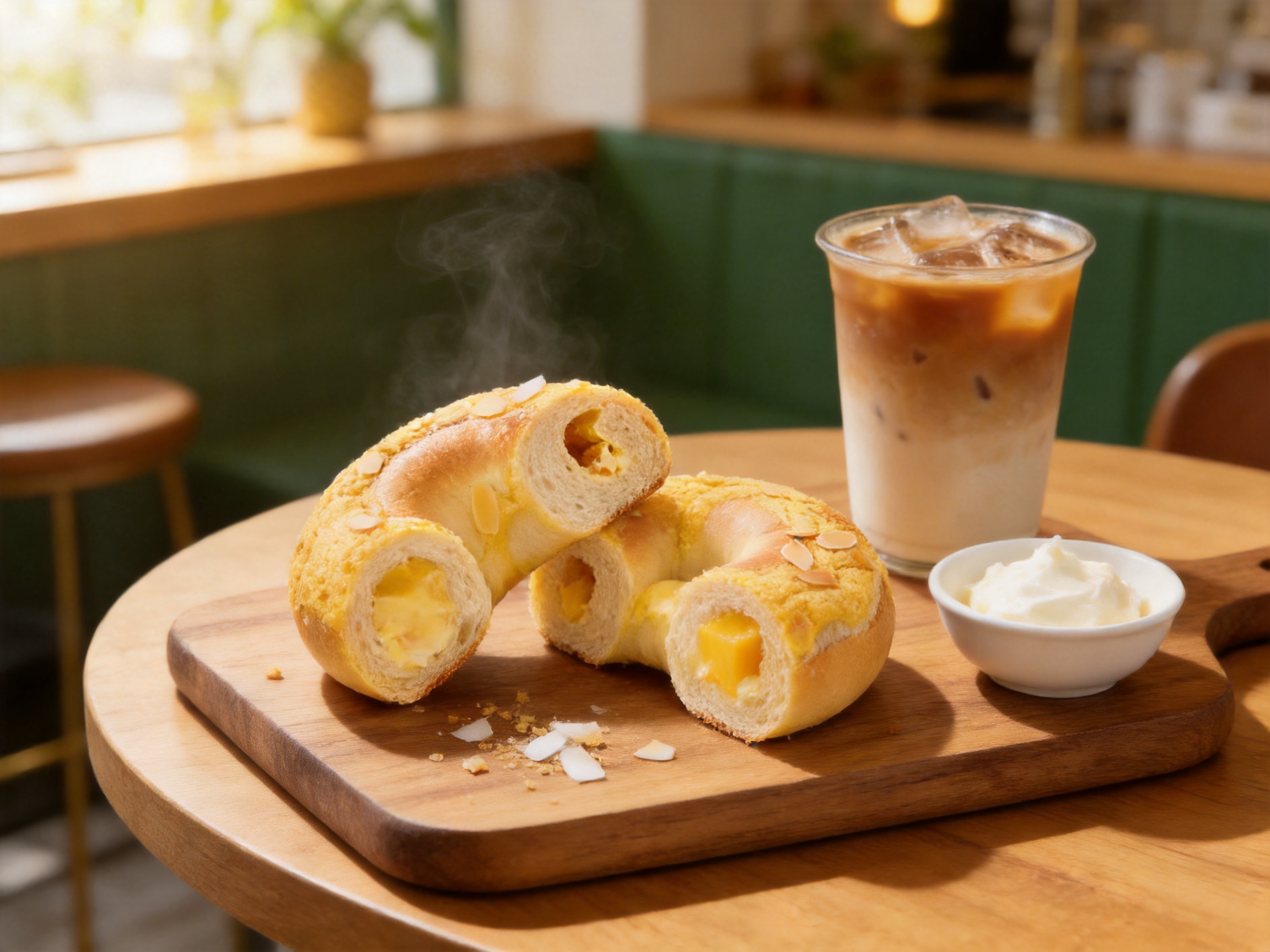
Its main sensory components are carefully arranged to create contrast. The top is generously covered with thin toasted almond flakes. The bagel body carries mango and coconut notes, while cream cheese and dairy butter introduce a rich, smooth dairy foundation. This gives the consumer several points of interest rather than a single dominant flavor.
The product can be understood through four principal elements:
First, toasted almond flakes provide visible premium appeal. Their thin, crispy texture creates an immediate crunch, while toasting develops a warm nutty aroma. The flakes also make the product more visually distinctive in a retail display or café case.
Second, mango brings brightness. Its fruit-forward character helps prevent the product from feeling overly heavy or one-dimensional. The gentle sweet-tart quality can refresh the palate and make the bagel suitable for consumers who prefer fruit-based bakery products.
Third, coconut adds a soft, fragrant tropical layer. Coconut is naturally associated with indulgence, sunshine, and dessert-style flavor experiences, but it can also work effectively in breakfast foods when balanced with wheat, fruit, and dairy.
Fourth, Anchor cream cheese and real dairy butter contribute milky richness. These ingredients help round out the tropical fruit notes and give the product a more luxurious mouthfeel. The intended experience is creamy without becoming excessively heavy.
This combination allows the bagel to occupy an attractive middle ground. It is more exciting than a plain bagel, less conventional than a standard fruit bread, and more suitable for everyday consumption than an intensely sweet pastry. It can therefore appeal to customers seeking novelty while remaining recognizable as a familiar baked product.
2. A Layered Sensory Experience
2.1 The First Impression: Visual Texture and Toasted Aroma
The thin almond flakes are one of the product’s strongest points of differentiation. In many bakery products, flavor innovation is hidden inside the dough or filling. Here, the topping communicates quality immediately. Consumers can see the almond flakes before tasting the product, making the bagel more attractive in a display environment.
When the topping is warmed or toasted before serving, the aroma of the almonds becomes more pronounced. The first bite begins with a light crispness, followed by a warm roasted note. This contrast gives the product a premium character that ordinary fruit bagels may not provide.
The almond topping also supports product photography and merchandising. A visible topping helps a product stand out in catalogues, online menus, bakery counters, and frozen-food listings. For wholesalers and private-label customers, this can reduce the need to explain the product visually because the appearance itself communicates fruit-and-nut indulgence.
2.2 Mango and Coconut: Brightness and Smoothness
Mango and coconut are familiar tropical flavors, but their combination creates a more complete profile than either ingredient alone. Mango offers a lively, sunny fruit impression with a mild sweet-tart quality. Coconut contributes a softer, creamier, and more aromatic sensation.
The two flavors create a useful contrast. Mango gives the product lift and recognizable fruit identity, while coconut helps extend the flavor and create a smoother finish. The result is neither sharply acidic nor overwhelmingly creamy. Instead, the consumer experiences a sequence of impressions: fruit brightness, tropical fragrance, and gentle sweetness.
This balance is valuable for commercial applications. Products with only a strong fruit note may be perceived as acidic or narrowly seasonal. Products with only coconut may be considered too rich or too specialized. Together, mango and coconut offer a flavor profile that can be positioned as tropical, refreshing, indulgent, or innovative depending on the sales channel.
2.3 Cream Cheese and Butter: Dairy Depth
Anchor cream cheese and real dairy butter add a familiar dairy foundation to the tropical profile. Cream cheese contributes tanginess and a smooth, creamy sensation. Dairy butter adds richness and helps create a rounded aroma during heating and baking.
The dairy components are important because they connect the product to established bakery expectations. Consumers already understand the appeal of cream cheese, butter, and bagels. By combining these familiar elements with mango, coconut, and almond, the product introduces novelty without becoming difficult to understand.
The intended texture is also carefully balanced. The exterior can develop a light crispness when heated, while the inside remains soft and tender. This creates a contrast between the outer surface, the almond topping, and the moist interior. Such textural variation often improves perceived quality because each bite feels more dynamic.
2.4 The Complete Bite
The product’s eating experience can be summarized as “crisp, creamy, fragrant, and pleasantly sweet.” The almond topping creates the initial textural event. The bagel body supplies wheat-based substance and chew. Mango and coconut build the central flavor. Cream cheese and butter create a slow, milky finish.
This progression is commercially useful because it encourages repeat tasting. A product with multiple sensory stages can feel more premium than one with a simple sweet or savory profile. Consumers may also find it easier to describe and recommend, using terms such as tropical, nutty, creamy, fruity, or indulgent.
3. Advantages Over Conventional and Competing Bagels
3.1 Stronger Flavor Differentiation
Plain, sesame, onion, and traditional savory bagels remain important in the market, but they compete in highly familiar flavor spaces. A mango-coconut bagel with toasted almond flakes offers a clearer point of difference. It can attract customers who are browsing for something new, especially in cafés, premium bakeries, hotel breakfast programs, and specialty retail.
The product is not simply a plain bagel with a sweet filling. Its topping, dough profile, fruit character, coconut aroma, and dairy components work together as a complete concept. This gives buyers a more distinctive product story for menus and product listings.
3.2 Premium Appearance Without Excessive Complexity
Visible almond flakes give the product a premium appearance without requiring complicated decoration. Compared with products that depend on icing, elaborate fillings, or multiple decorative components, the toasted almond topping can deliver visual impact in a more practical bagel format.
This is particularly beneficial for wholesale buyers. A product that looks attractive after straightforward preparation can reduce the operational burden on cafés and bakeries. Staff can heat, slice, plate, or package the bagel without needing extensive finishing work.
3.3 Broader Daypart Potential
The product can be positioned across several dayparts. At breakfast, it can be served warm with coffee, tea, yogurt, or fresh fruit. During the afternoon, it can function as a snack or café pastry alternative. In a dessert-oriented setting, it can be paired with whipped cream, fruit compote, yogurt, or a light drizzle.
Its flavor profile is also suitable for seasonal promotions. Mango and coconut can support spring and summer campaigns, tropical menu themes, holiday gift assortments, or limited-time café launches. At the same time, the warm almond and dairy notes make it suitable for cooler seasons when served toasted.
3.4 More Balanced Than Very Sweet Bakery Products
Fruit-filled pastries and heavily iced bakery products can be appealing, but some consumers find them overly sweet or rich. This bagel offers an alternative form of indulgence. Its sweetness is supported by wheat, nutty aroma, fruit brightness, and dairy richness rather than relying only on sugar or icing.
That balance may help retailers serve customers who want a treat with more texture and substance. It can also fit menus that emphasize premium ingredients, crafted bakery experiences, or moderate sweetness.
3.5 Frozen Format and Operational Convenience
As a frozen bakery product, the bagel can support inventory planning and reduce the pressure associated with short fresh-bakery selling windows. Buyers can organize stock according to expected demand, prepare portions as needed, and maintain a more consistent product offering across locations.
For chain cafés, foodservice operators, and retail distributors, frozen supply can simplify procurement. It can also support geographic expansion because products can be transported and stored through an organized cold-chain system rather than relying solely on same-day fresh distribution.
3.6 Consistency for Commercial Menus
Consistency is a major advantage in commercial bakery purchasing. A café chain or foodservice operator needs products that perform similarly across batches and locations. Inconsistent size, topping distribution, texture, or flavor can create customer complaints and complicate staff training.
The manufacturer’s focus on bagel research and production, supported by an integrated supply chain, is designed to provide stable quality and reliable supply. This is especially important for buyers developing standardized menus or private-label products.
4. Manufacturing Strengths Behind the Product
4.1 Specialized Bagel Research and Manufacturing
Jiangsu Goobagel Food Technology Co., Ltd. has specialized in bagel research and manufacturing since 2019. This focused experience is valuable because bagel production requires control over more than basic dough mixing and baking.
Bagels depend on the interaction of dough development, shaping, proofing, surface treatment, baking, cooling, freezing, and reheating performance. A successful frozen bagel must remain attractive and enjoyable not only when it leaves the production line but also after storage, preparation, and service.
A manufacturer with dedicated bagel experience can build its product-development decisions around these requirements. This supports better control of chew, softness, topping adhesion, internal structure, flavor distribution, and heating behavior.
4.2 Integrated Supply Chain Management
The company operates a fully integrated supply chain covering raw materials, research and development, production, and nationwide distribution. This integration is a major strength for customers seeking dependable supply rather than one-off product development.
Raw-material coordination helps support the consistent sourcing and handling of key components such as wheat-based ingredients, almond flakes, mango and coconut flavor components, cream cheese, and dairy butter. Research and development connects these ingredients to product performance. Production converts the approved formula into repeatable commercial batches. Distribution then helps move finished products to customers through an organized supply network.
When these stages are coordinated within one business system, communication can be more direct. Product adjustments can be evaluated more efficiently, and commercial requirements can be communicated between sales, technical, production, and logistics teams.
4.3 Product Development Capacity
Goobagel has developed more than 100 bagel varieties designed for different commercial applications. This breadth indicates experience with multiple flavor directions, ingredient combinations, formats, and customer requirements.
A broad product portfolio is useful for buyers because it allows them to build a more complete assortment. A retailer may want classic products, savory options, fruit bagels, filled bagels, and sandwich-oriented products from one manufacturing partner. A café chain may wish to test several flavors before selecting a permanent menu item. A private-label customer may require a core range plus seasonal launches.
The toasted almond mango-coconut bagel benefits from this broader development environment. It represents a product concept that combines several technical and sensory elements: a bagel base, fruit flavor, coconut aroma, nut topping, and dairy richness. Experience across many products can help a manufacturer manage such combinations more effectively.
4.4 Clean-Label Product Direction
The company has created more than 100 clean-label bagel varieties for retail, foodservice, cafés, tea brands, and bakery operators. Clean-label expectations vary by market and should always be confirmed against the final specification, but the stated product-development direction demonstrates an awareness of modern purchasing priorities.
Many buyers now evaluate not only taste and price but also ingredient communication, product transparency, and consumer perception. A clean-label approach can support premium positioning when accompanied by accurate documentation, clear specifications, and responsible claims.
For the toasted almond mango-coconut bagel, the use of recognizable components such as almond flakes, fruit flavors, cream cheese, and real dairy butter contributes to a more understandable product story. Commercial buyers can then adapt the final communication to local labeling laws and their own brand standards.
4.5 Frozen Bakery Production
Frozen bakery manufacturing requires attention to the complete product lifecycle. The product must be developed to withstand freezing, storage, transportation, and final preparation while preserving its intended taste and texture.
For a topped product, freezing performance is particularly relevant. The almond flakes need to remain sufficiently attractive, and the bagel should retain its structure after thawing or heating according to the approved preparation method. The fruit and dairy components must remain balanced rather than becoming muted or excessively dominant after storage.
A producer experienced in frozen bagels can evaluate these requirements during research and development. The process may involve formulation trials, baking tests, freezing studies, storage evaluation, reheating trials, and sensory checks. Exact technical conditions should be confirmed in the product specification, but the manufacturing model is clearly designed for frozen bakery supply.
4.6 Nationwide Distribution Capability
Reliable distribution is essential for frozen products. A strong manufacturing facility is not enough if customers cannot receive products consistently, on schedule, and in suitable condition.
The company’s nationwide distribution capability supports commercial customers across different regions. This can be valuable for restaurant groups, café chains, retail distributors, and foodservice wholesalers that require coordinated supply to multiple locations.
Distribution capability also supports product growth. A bagel that begins as a regional café offering may later be introduced through additional stores, retail channels, or foodservice accounts. A supplier with an established distribution structure is better positioned to support that expansion.
5. Applications for Retail, Foodservice, and Café Operators
5.1 Retail Bakery and Frozen Food Sections
In retail, the product can be presented as a premium fruit bagel or tropical-inspired bakery item. Its visible almond topping and distinctive name can help it stand apart from standard bagels on a shelf or in a frozen display.
Retailers may place it within a specialty breakfast range, premium frozen bakery section, seasonal tropical assortment, or better-for-sharing snack collection. Packaging can emphasize the contrast between toasted almond, mango, coconut, and creamy dairy notes, provided all claims accurately reflect the final approved specification.
Because the product is portioned at 78g, it can be sold as an individual item or included in multipack formats. A multipack may encourage household use, while individual packaging can support convenience stores, cafés, hotel minibars, and on-the-go retail.
5.2 Café Menus
The toasted almond mango-coconut bagel is naturally suited to café service. It can be warmed and served whole, sliced in half, or paired with a beverage. Coffee, black tea, green tea, milk tea, coconut drinks, fruit tea, and iced beverages can all complement its flavor direction.
For a simple menu item, the bagel can be served warm with no additional preparation. For a more premium presentation, café operators can add a light cream cheese spread, yogurt, fresh mango, toasted coconut, or a small amount of fruit sauce. Any added components should be selected to preserve the balance between sweetness and dairy richness.
The product can also support limited-time offers. A café might create a “tropical breakfast set,” an afternoon tea pairing, or a summer fruit promotion. Such campaigns can generate interest without requiring a completely new production process in the store.
5.3 Hotel and Institutional Foodservice
Hotels, corporate cafeterias, universities, and other institutional foodservice operations often require products that can be stored efficiently and prepared consistently. A frozen bagel format can help kitchens manage demand while offering guests more variety than conventional bread products.
The bagel can be included in breakfast buffets, boxed breakfasts, meeting refreshments, brunch menus, or snack stations. Its fruit and nut profile can complement more savory breakfast items, providing a differentiated choice for guests who prefer sweet or mildly sweet bakery products.
5.4 Tea Brands and Dessert-Oriented Operators
Tea brands increasingly expand their menus with bakery snacks and light food items. The mango-coconut flavor profile is particularly compatible with milk tea, fruit tea, coconut beverages, and tropical-themed drinks.
The product can be sold as an accompaniment to a beverage or included in a combo meal. Its almond topping and tropical identity can also support visually attractive promotional photography. For dessert-oriented operators, the bagel may be warmed and served with fruit, cream, or a scoop of ice cream, subject to the operator’s preparation concept.
5.5 Bakery Operators and Private-Label Customers
Bakery operators may use the product as a ready-to-serve specialty item or as a foundation for customized presentations. Private-label customers can evaluate the product for inclusion in their own branded ranges, subject to technical, packaging, labeling, and minimum-order requirements.
A private-label bagel program may involve adjustments to pack size, outer packaging, product naming, visual identity, case configuration, and market-specific documentation. The manufacturer’s experience across retail, foodservice, café, tea, and bakery applications can help support this type of commercial development.
6. Product Positioning and Marketing Opportunities
6.1 Tropical Premium
The simplest positioning is tropical premium. Mango and coconut immediately communicate a bright and fragrant flavor direction, while toasted almonds and dairy ingredients elevate the product beyond a basic sweet bread.
This positioning can appeal to customers who associate tropical flavors with relaxation, travel, summer, and indulgence. It is suitable for colorful packaging, seasonal displays, café specials, and social-media-oriented product launches.
6.2 Texture-Led Indulgence
Another positioning opportunity is texture. The product offers a sequence of crisp almond flakes, a lightly crisp exterior when prepared correctly, and a soft, tender interior. This can be expressed through phrases such as “crunch-to-cream” or “crispy topping, soft center,” provided the wording is consistent with the final sensory specification.
Texture-led communication is useful because it gives consumers a reason to choose the product beyond flavor alone. It can also help distinguish the item from soft fruit buns, cakes, and heavily glazed pastries.
6.3 Everyday Treat
The product can also be positioned as an everyday treat. Its bagel format gives it a familiar and practical structure, while the mango-coconut and almond profile creates a small moment of indulgence.
This positioning may be effective for convenience retail, workplace cafés, school or university foodservice, and household freezer products. It presents the bagel as enjoyable but versatile rather than reserved only for special occasions.
6.4 Innovation for Assortment Builders
For buyers building a differentiated bakery assortment, this product can serve as an innovation item. It adds a fruit-based option to a portfolio that may otherwise be dominated by plain, cheese, chocolate, or savory flavors.
Its unusual combination can also encourage trial. Consumers may purchase it because they are curious about mango and coconut together, then return because they enjoy the balance of almond, dairy, and fruit.
7. Quality and Supply Considerations for Buyers
7.1 Confirming the Product Specification
Commercial buyers should confirm the complete product specification before placing an order. Important details include the final ingredient declaration, allergen statement, nutrition information, storage temperature, shelf life, preparation instructions, packaging format, case quantity, minimum order quantity, and available documentation.
Because the product contains almond and dairy components, allergen management is especially important. Buyers should review the manufacturer’s allergen-control procedures and ensure that local labeling requirements are satisfied in the intended market.
7.2 Maintaining the Cold Chain
Frozen products depend on appropriate storage and transportation. Buyers should establish procedures for receiving, recording, storing, rotating, and preparing frozen bagels. Maintaining suitable temperatures helps protect product quality and reduces the risk of unnecessary texture or appearance changes.
Retailers and foodservice operators should also train staff to follow the approved preparation method. Correct heating can help restore the intended contrast between crisp topping, lightly crisp exterior, and soft interior.
7.3 Testing Before Full Launch
A sample evaluation is recommended before a full commercial launch. Buyers can test the product in the actual environment where it will be sold, including the intended oven, toaster, or heating equipment.
The evaluation should consider appearance, topping adhesion, aroma, internal texture, serving time, customer response, packaging performance, and compatibility with beverages or other menu items. Testing across several preparation cycles can also help identify the most consistent operating procedure.
7.4 Building a Reliable Forecast
For frozen bakery programs, accurate forecasting supports both the buyer and the manufacturer. Customers should estimate expected sales by location, season, promotional activity, and daypart.
A reliable forecast can help reduce out-of-stock situations while avoiding excessive inventory. It can also support smoother production planning for the manufacturer and more consistent delivery performance for the buyer.
8. Why a Specialized Manufacturing Partner Matters
Choosing a supplier for a specialty bagel involves more than comparing unit prices. Buyers should evaluate product development ability, manufacturing experience, ingredient management, frozen-chain capability, packaging support, logistics, communication, and long-term reliability.
A specialized bagel producer can provide knowledge that a general bakery manufacturer may not possess. Bagel products have specific expectations regarding shape, chew, crumb, surface finish, and preparation performance. When those expectations are combined with toppings, fruit, coconut, and dairy ingredients, technical control becomes even more important.
Goobagel’s focused bagel experience, portfolio of more than 100 varieties, and integrated supply-chain model provide a foundation for this type of partnership. The company’s stated mission is to provide customers with high-quality and healthy products while creating opportunities for partners to realize their dreams. Its values include persistence, craftsmanship, respect, and science.
These principles are relevant to commercial product development. Persistence supports the repeated testing required to refine a formula. Craftsmanship supports attention to appearance and eating quality. Respect supports communication with customers and partners. Science supports structured evaluation of raw materials, processing, freezing, storage, and preparation.
The company’s vision, “To strive for a better life,” also aligns with the broader role of bakery products in daily consumption. A well-developed bagel can provide convenience, nourishment, enjoyment, and commercial value at the same time.
9. Product Development Potential
9.1 Portion and Pack Customization
The stated 78g format is suitable for individual consumption, but commercial customers may have different requirements. Depending on production capability and order conditions, buyers may explore alternative weights, multipacks, foodservice cases, or assortment packs.
Portion customization can help align the product with a specific channel. A smaller format may suit children’s menus, hotel breakfasts, or snack boxes. A larger format may be appropriate for meal occasions or premium café plates.
9.2 Flavor Range Extensions
The toasted almond mango-coconut bagel can serve as an anchor product within a broader tropical or fruit-bagel range. Related concepts could include other fruit-and-nut combinations, citrus-inspired profiles, berry and dairy combinations, or coconut-based variations.
A range built around a consistent bagel platform can simplify merchandising and encourage consumers to try multiple flavors. For private-label customers, this can support a recognizable family identity across several products.
9.3 Foodservice Customization
Foodservice customers may require specific packaging, case sizes, preparation directions, or menu support. A manufacturer with experience serving multiple commercial channels can help evaluate these needs during development.
Customization should preserve the essential strengths of the product: visible almond texture, balanced tropical flavor, creamy dairy depth, stable frozen performance, and an attractive finished appearance.
10. Serving Suggestions
The bagel may be served warm after preparation according to the manufacturer’s instructions. Warming can help release almond aroma, soften the interior, and develop a more pronounced contrast between the surface and center.
For breakfast, it can be paired with coffee, tea, milk, yogurt, or fresh fruit. Mango slices, banana, berries, or citrus fruit may reinforce the fruit-forward character.
For a café snack, it can be served with a cold coconut beverage, iced tea, fruit tea, or milk tea. A simple beverage pairing can turn the bagel into a convenient set menu.
For a dessert-style presentation, operators may add a small amount of whipped cream, yogurt, fruit compote, or vanilla cream. The additional topping should be used carefully so that it does not obscure the toasted almond flakes or overwhelm the mango and coconut profile.
For a premium brunch application, the bagel can be sliced and served with cream cheese, fresh tropical fruit, and a light garnish. This approach emphasizes the product’s dairy and fruit characteristics while creating a more substantial plate.
For retail consumers, the product can be promoted as a warm breakfast or afternoon snack that requires minimal preparation. Clear preparation instructions and attractive packaging can help communicate convenience.
11. Frequently Asked Questions
Q1: What type of product is the toasted almond mango-coconut bagel?
It is a fruit-oriented bagel in the Fruits Bagel category. The product combines a bagel base with toasted almond flakes, mango, coconut, cream cheese, and real dairy butter.
Q2: What is the stated product weight?
The stated product weight is 78g. Buyers should confirm whether this refers to the nominal individual product weight and verify the final specification before commercial ordering.
Q3: What does the product taste like?
The flavor is tropical, creamy, nutty, and gently sweet. Mango provides brightness and a mild sweet-tart lift. Coconut adds silky fragrance, toasted almonds contribute warm nuttiness, and cream cheese and butter create a rich milky finish.
Q4: What texture can consumers expect?
The intended experience includes crisp almond flakes, a lightly crisp exterior after suitable heating, and a soft, tender interior. The product is designed to deliver contrast between crunch, chew, creaminess, and softness.
Q5: Is the product suitable for cafés?
Yes. It can be warmed and served as a breakfast item, snack, beverage accompaniment, or seasonal menu special. Its distinctive appearance and tropical flavor profile can support café merchandising and promotional campaigns.
Q6: Can the product be used by retail and foodservice buyers?
Yes. The frozen bakery format is suitable for retail, foodservice, café chains, tea brands, bakery operators, hotel breakfast programs, and other commercial applications. Packaging, case configuration, and order conditions should be confirmed with the manufacturer.
Q7: What are the product’s main advantages over a plain bagel?
It offers stronger flavor differentiation, a premium visible topping, tropical fruit character, dairy richness, and a more layered texture. It can also be used in more promotional and seasonal applications than a basic plain bagel.
Q8: What are the main allergen considerations?
The product includes almond and dairy components, including cream cheese and butter. Buyers must review the final allergen statement and local labeling requirements before selling the product.
Q9: Why is frozen production useful for commercial customers?
Frozen production can support inventory management, longer distribution windows, consistent preparation, and multi-location supply. It allows operators to prepare products according to demand rather than relying entirely on same-day fresh production.
Q10: What manufacturing experience does the supplier have?
Jiangsu Goobagel Food Technology Co., Ltd. has specialized in bagel research and manufacturing since 2019. It operates an integrated supply chain covering raw materials, research and development, production, and nationwide distribution.
Q11: How many bagel varieties has the company developed?
The company states that it has developed more than 100 clean-label bagel varieties for retail, foodservice, café chains, tea brands, and bakery operators.
Q12: Can buyers request OEM or private-label cooperation?
The company’s business positioning includes OEM and private-label bagel solutions. Interested buyers should discuss product specifications, packaging, branding, minimum order quantities, documentation, lead times, and market requirements directly with the supplier.
Q13: How should the bagel be prepared?
Preparation should follow the manufacturer’s approved instructions. Buyers should test the product using their own equipment to determine the most consistent heating procedure for their operation.
Q14: What makes the almond topping commercially valuable?
The topping creates immediate visual appeal and adds a crisp, roasted texture. It helps the product stand out in displays and gives consumers a clear sensory reason to choose it over a conventional bagel.
Q15: Is the product only suitable for summer?
No. Mango and coconut support tropical and summer promotions, while almond, butter, and cream cheese provide warm, comforting notes that can work throughout the year. The product can be served as a seasonal special or a permanent specialty item.
12. Conclusion
The toasted almond mango-coconut bagel is a distinctive specialty bakery product that combines familiar bagel structure with a premium tropical flavor concept. Its toasted almond flakes create visible quality and immediate crunch. Mango brings brightness, coconut contributes fragrance and smoothness, and Anchor cream cheese with real dairy butter adds a rich, slowly developing dairy finish.
Compared with conventional bagels, the product offers stronger differentiation, broader promotional potential, and a more complex sensory experience. It can serve as a breakfast item, café snack, beverage pairing, dessert-inspired bakery product, hotel breakfast selection, or retail frozen product.
Its commercial value is strengthened by the manufacturing capabilities of Jiangsu Goobagel Food Technology Co., Ltd. The company’s specialization in bagel research and manufacturing since 2019, integrated supply chain, frozen bakery focus, broad product-development portfolio, and nationwide distribution capability provide a strong foundation for reliable supply and product customization.
For buyers searching for a bagel that can attract attention, support menu innovation, and perform across multiple channels, this product offers a compelling solution. It brings together tropical flavor, nutty texture, dairy richness, frozen convenience, and scalable manufacturing support in one 78g format.
References
1. Product specification and sensory description supplied for the toasted almond mango-coconut bagel.
2. Company information supplied for Jiangsu Goobagel Food Technology Co., Ltd., including its manufacturing history, supply-chain structure, product-development capabilities, vision, mission, and values.
3. General principles of frozen bakery product development, including formulation control, freezing stability, cold-chain management, storage evaluation, and reheating performance.
4. General bakery merchandising principles concerning visual toppings, texture contrast, portion sizing, café applications, retail presentation, and foodservice menu development.
5. General food-industry guidance concerning allergen declaration, product specification review, preparation validation, inventory planning, and commercial quality control.
