
 中文简体
 English





postmaster@goobagelfood.com
Content
- 1 What Makes a Pretzel Bagel Different?
- 2 The Importance of the Lye Bath
- 3 High-Temperature Baking and Maillard Development
- 4 Texture: Lightly Crisp Outside, Elastic Inside
- 5 Wheat-Forward Flavor Profile
- 6 Advantages Over Conventional Bagels
- 7 Advantages Over Ordinary Pretzel Products
- 8 Commercial Product Specifications
- 9 Manufacturing Strengths of Jiangsu Goobagel Food Technology Co., Ltd.
- 10 Quality Consistency at Production Scale
- 11 Frozen Bakery Advantages for Commercial Buyers
- 12 OEM and Private-Label Opportunities
- 13 Applications Across Foodservice
- 14 Menu Pairing Ideas
- 15 Why the Product Supports Premium Positioning
- 16 Food Safety and Process Responsibility
- 17 Supply Chain and Distribution Capability
- 18 Choosing the Right Product for Different Markets
- 19 Quality Evaluation Criteria for Buyers
- 20 Environmental and Operational Considerations
- 21 Frequently Asked Questions
- 21.1 What is the High-Temperature Baking Pretzel Bagel?
- 21.2 How does the product differ from a standard plain bagel?
- 21.3 Why is the lye bath important?
- 21.4 What does high-temperature baking contribute?
- 21.5 Is the crust hard like a dry pretzel?
- 21.6 What fillings work well with this bagel?
- 21.7 Can it be used for sandwiches?
- 21.8 Who manufactures the product?
- 21.9 Does the manufacturer offer OEM or private-label cooperation?
- 21.10 What types of businesses can use this product?
- 21.11 How should buyers evaluate the product before ordering?
- 21.12 Is the lye process suitable for small-scale untrained preparation?
- 22 Conclusion
- 23 References
- 24 Product: High-Temperature Baking Pretzel Bagel
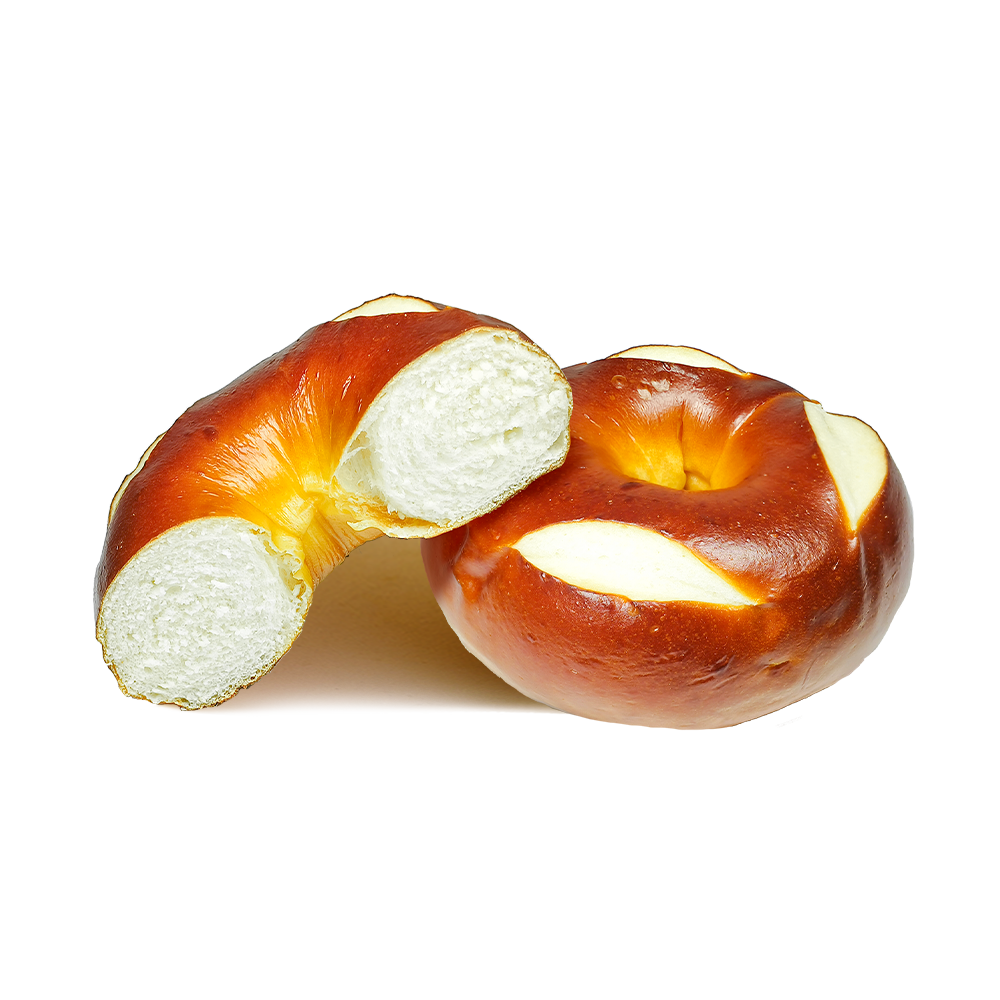
The High-Temperature Baking Pretzel Bagel combines the familiar shape and versatility of a bagel with the distinctive crust, aroma, and visual appeal of a traditional pretzel. Designed for commercial foodservice, retail, café, bakery, and private-label applications, this 100-gram product delivers a bold appearance and dependable eating quality from the first bite to the last.
Its defining characteristics come from a carefully controlled process: each bagel receives a lye bath of more than 30 seconds before entering a high-temperature baking stage. This treatment helps form the characteristic glossy brown exterior associated with premium pretzel products. The result is a crust that is lightly crisp, resilient, savory, and visually striking, while the interior maintains the chewy, wheat-forward character expected from a quality bagel.
For buyers, distributors, and foodservice operators, the product offers more than an attractive crust. It provides a reliable foundation for breakfast menus, sandwich programs, grab-and-go displays, café offerings, catering platters, and creative culinary applications. Its strong identity allows it to stand out as a signature product, while its neutral wheat profile makes it easy to pair with sweet, savory, and indulgent ingredients.
Manufactured by Jiangsu Goobagel Food Technology Co., Ltd., the product reflects the capabilities of a modern frozen bakery producer with expertise in research, product development, production, and distribution. The company has specialized in bagel research and manufacturing since 2019 and has developed more than 100 clean-label bagel varieties for retail, foodservice, café chains, tea brands, and bakery operators.
What Makes a Pretzel Bagel Different?
A conventional bagel is generally recognized for its rounded form, central opening, dense crumb, and chewy texture. A pretzel bagel preserves many of these familiar characteristics but adds a distinctive alkaline-treated crust. The alkaline bath changes the behavior of the dough surface during baking, encouraging deeper browning, greater sheen, and a flavor profile associated with pretzels.
The High-Temperature Baking Pretzel Bagel is designed around this contrast between a bold outer crust and a substantial interior. The surface offers a lightly crisp first contact, followed by an elastic and wheat-forward crumb. This layered texture gives the product a stronger sensory identity than an ordinary plain bagel without making it difficult to use in daily menu operations.
The appearance is equally important. The deep brown exterior communicates warmth, freshness, and craftsmanship before the product is even cut open. In a display cabinet, buffet, café counter, or retail freezer, the glossy surface creates an immediate point of visual differentiation. This can be especially valuable for operators seeking a product that looks premium without requiring complicated finishing procedures at the point of sale.
Unlike highly flavored or heavily topped products, the Pretzel Bagel achieves recognition through process rather than decoration. Its identity comes from the crust, baking profile, aroma, and grain character. This makes it suitable for operators that want a distinctive product while preserving flexibility across multiple recipes and service styles.
The Importance of the Lye Bath
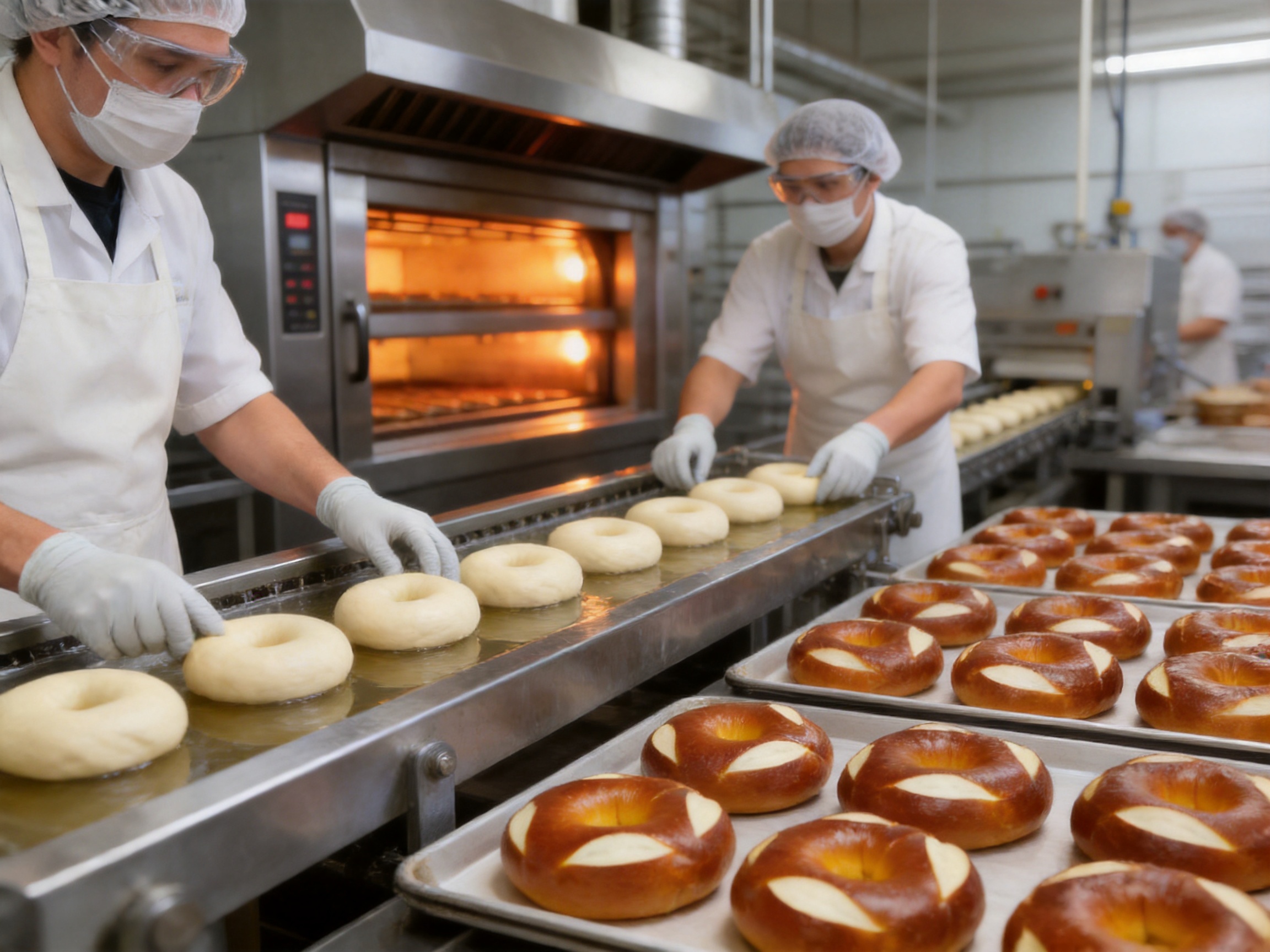
The lye bath is one of the central elements of a traditional pretzel-style process. In professional bakery manufacturing, an alkaline treatment is applied to the dough surface before baking. For this product, every piece is immersed for more than 30 seconds, allowing the surface to develop the structure needed for its characteristic finish.
This stage is not simply a coating step. It prepares the exterior for the high-temperature baking process that follows. The treated surface becomes capable of developing a deeper and more uniform brown color, while also contributing to the glossy appearance and savory aroma associated with pretzel products.
Control is essential. The immersion time, solution management, product handling, and transfer to the oven must be coordinated carefully. Insufficient treatment may produce a pale or underdeveloped crust, while inconsistent treatment can lead to variation in color, surface character, and flavor. A professional production environment allows these variables to be monitored more effectively than a small, improvised process.
Because lye is a caustic material, this stage should be handled only by trained personnel using appropriate industrial safety procedures and equipment. The commercial value of the process lies not only in the ingredient itself but in the manufacturer’s ability to control it safely and consistently at production scale.
For buyers, the practical benefit is repeatability. Every finished bagel is expected to deliver a recognizable crust and a consistent appearance. This helps foodservice operators maintain the same menu experience across multiple shifts, locations, and replenishment cycles.
High-Temperature Baking and Maillard Development
After the lye bath, the bagels are baked at high temperature to develop the final crust. High-temperature baking encourages a full Maillard reaction, a complex series of reactions between amino acids and reducing sugars that contributes to browning, roasted aromas, and deeper flavor.
The Maillard reaction is one reason the surface of a well-baked pretzel product can smell so appealing when it leaves the oven. It creates aromas that may be described as toasted grain, roasted wheat, baked dough, and light savory notes. These aromas help communicate freshness and can increase the sensory appeal of the product at the point of service.
The baking profile must be balanced carefully. Excessive heat or an unsuitable baking time can produce a surface that is too dry, too hard, or overly dark. Insufficient heat may result in a dull appearance and a less developed flavor. The manufacturing process therefore needs to coordinate oven temperature, baking duration, dough condition, and product size.
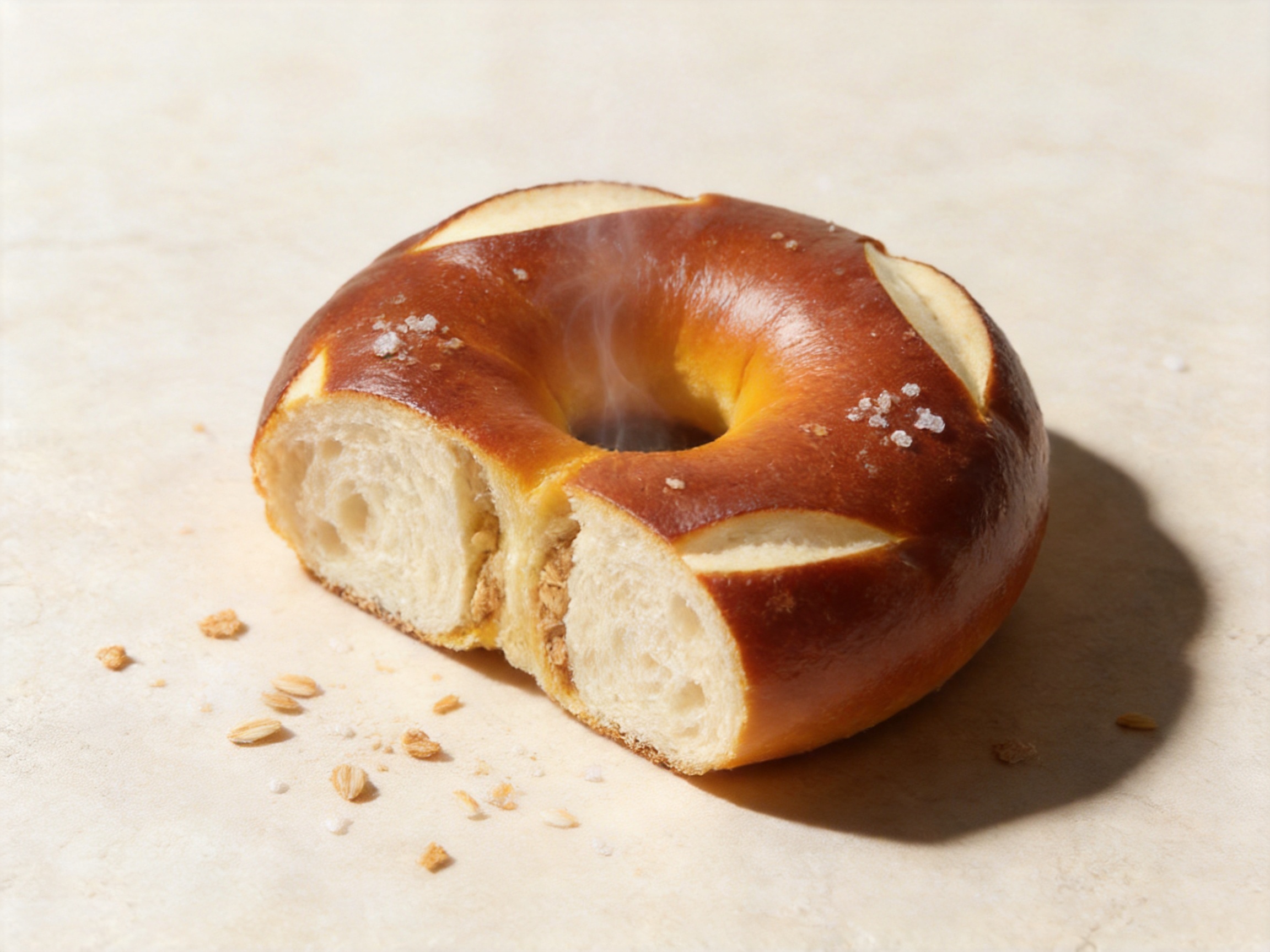
The High-Temperature Baking Pretzel Bagel is formulated to maintain a lightly crisp but resilient crust. The goal is not to create a brittle shell that breaks aggressively or becomes difficult to eat. Instead, the crust should provide a clean initial snap before giving way to a chewy and elastic interior.
This balance is a meaningful advantage over products that focus only on color. A dark surface by itself does not guarantee a satisfying product. Premium quality depends on the relationship between appearance, aroma, crust thickness, moisture retention, and crumb structure. The production process is designed to address these elements together.
High-Temperature Baking Pretzel Bagel
Texture: Lightly Crisp Outside, Elastic Inside
Texture is one of the strongest reasons consumers choose bagels and pretzel products. The High-Temperature Baking Pretzel Bagel is developed to create a two-stage eating experience. The first bite meets a lightly crisp outer crust, followed by a resilient interior with a substantial wheat character.
The crust is intended to be firm enough to communicate freshness and baking quality but not so hard that it becomes unpleasant. Its slightly dry surface helps deliver the familiar pretzel-like bite, while its resilience prevents the product from feeling fragile or powdery.
Inside, the crumb offers the chew associated with a bagel. This makes the product more satisfying than a light roll when used for sandwiches or breakfast builds. The interior has enough body to support fillings such as cream cheese, eggs, bacon, smoked fish, sliced meats, roasted vegetables, and cheese without collapsing immediately.
The relationship between crust and crumb also benefits reheating and finishing operations. Depending on the operator’s equipment and serving method, the bagel can be thawed, warmed, toasted, or incorporated into a sandwich assembly line. The exterior remains an important part of the product’s identity, while the interior provides a stable base for additional ingredients.
Texture consistency is particularly important for commercial customers. A product that varies widely from batch to batch can create complaints, waste, and difficulty in staff training. A controlled manufacturing system supports a more predictable result, helping operators serve the product with confidence.
Wheat-Forward Flavor Profile
The flavor of the Pretzel Bagel is bold but not overly complicated. Its main impression comes from toasted grain, baked wheat, light saltiness, and the savory character generated by the alkaline crust and high-temperature baking process.
This wheat-forward profile makes the product easy to merchandise and easy to pair. It can support rich fillings without disappearing beneath them, but it does not dominate the other ingredients as strongly as some cheese-, herb-, or spice-filled bakery products might.
For breakfast, the bagel works well with butter, cream cheese, egg, sausage, ham, bacon, and avocado. For lunch, it can be filled with roasted chicken, turkey, beef, smoked salmon, tuna, vegetables, or plant-based proteins. For snack menus, it can be cut into smaller portions or served with dips and spreads.
The flavor also allows creative sweet-and-savory combinations. Honey butter, maple cream cheese, apple slices, roasted pear, cinnamon spreads, and other mildly sweet ingredients can create contrast with the salty pretzel-style crust. This versatility can help operators develop seasonal or limited-time menu items without changing the core bakery supply.
Advantages Over Conventional Bagels
One of the clearest advantages of this product is visual differentiation. A plain bagel may blend into a crowded bakery display, while a glossy dark pretzel crust immediately attracts attention. The deeper color suggests a specialized baking method and gives the product a more premium presentation.
The second advantage is sensory recognition. Consumers may identify the product as a pretzel-style item from its aroma and crust even before tasting it. This clear identity can make menu descriptions easier and can support premium positioning in cafés, bakeries, and foodservice programs.
A third advantage is application flexibility. Some flavored bagels are closely tied to specific fillings or occasions. The Pretzel Bagel has a stronger personality than a plain bagel but remains broad enough for breakfast, lunch, snacks, catering, and retail use.
It also provides a useful middle ground between a traditional bagel and a soft pretzel. Operators can offer a product with pretzel character without managing a separate soft pretzel format. This can simplify menu planning and create opportunities for cross-category merchandising.
Finally, the product is suitable for frozen bakery supply chains. Commercial customers can purchase a consistent product, store it according to approved conditions, and plan production around demand rather than relying entirely on same-day preparation. This can reduce operational pressure while maintaining a freshly baked presentation when the product is properly handled and finished.
Advantages Over Ordinary Pretzel Products
Traditional pretzels are highly recognizable, but their shape and format may limit how they are used in some foodservice programs. A pretzel bagel provides the characteristic crust and aroma of a pretzel while offering the round, sandwich-friendly format of a bagel.
The central opening and broad surface make it easy to slice, fill, toast, display, and portion. This design is especially useful for café chains and quick-service operations that need products compatible with standard sandwich assembly procedures.
The bagel format also supports familiar consumer behavior. Customers already understand how to eat a bagel, what fillings are appropriate, and how it fits into breakfast or lunch occasions. The pretzel treatment adds novelty without requiring a completely unfamiliar product experience.
In addition, the product can be integrated into menus that already use bagel packaging, trays, display fixtures, and preparation equipment. This may reduce the need for new operational systems compared with introducing a separate pretzel category.
Commercial Product Specifications
| Item | Specification | Commercial Benefit |
|---|---|---|
| Product name | High-Temperature Baking Pretzel Bagel | Clear positioning as a premium pretzel-style bagel |
| Product weight | 100 grams | Suitable for individual servings, sandwiches, and portion planning |
| Product category | Original Bagel | Compatible with broad bagel menus and bakery assortments |
| Surface treatment | Lye bath exceeding 30 seconds | Supports glossy color, savory aroma, and pretzel-style crust development |
| Baking method | High-temperature baking | Encourages strong browning and Maillard flavor development |
| Texture | Lightly crisp crust with resilient interior | Provides contrast and supports fillings |
| Primary flavor | Toasted wheat with savory, lightly salty notes | Pairs with sweet, savory, and premium ingredients |
| Application range | Retail, cafés, foodservice, catering, and bakery operations | Supports multiple sales channels and menu formats |
Manufacturing Strengths of Jiangsu Goobagel Food Technology Co., Ltd.
Jiangsu Goobagel Food Technology Co., Ltd. is a modern frozen bakery producer specializing in bagel research and manufacturing. Since 2019, the company has focused on developing products that combine consumer appeal with the consistency required by commercial customers.
Its operations cover raw materials, research and development, production, and nationwide distribution. This integrated supply chain gives the company greater control over the movement of materials and finished products. It also supports closer coordination between product development and manufacturing execution.
For a specialized product such as the Pretzel Bagel, this integration is important. The lye bath, high-temperature baking, crust development, freezing, storage, and distribution stages must work together. A strong product concept can lose its value if later stages are not managed properly. An integrated system helps protect the intended texture and appearance through the commercial supply chain.
The company has created more than 100 clean-label bagel varieties. This product development experience demonstrates the ability to work with different dough systems, flavor profiles, formats, and customer requirements. It also provides a broader technical foundation for developing customized products for retail and foodservice buyers.
Goobagel Food works with leading brands across China and provides bagel solutions for retail, foodservice, café chains, tea brands, and bakery operators. These customer groups have different requirements. Retail customers may prioritize packaging, shelf presentation, and consumer recognition. Café chains may require preparation consistency and menu flexibility. Foodservice operators may focus on yield, portion control, and supply reliability.
Serving multiple sectors requires a manufacturing organization that can adapt its product development and quality systems to different commercial objectives. This experience is a competitive strength for buyers seeking OEM or private-label cooperation.
Quality Consistency at Production Scale
Consistency is one of the most important differences between artisanal experimentation and commercial bakery manufacturing. A product may taste excellent in a single test batch but fail to meet customer expectations if its size, crust color, texture, or flavor varies during larger production runs.
The Pretzel Bagel is designed with repeatable production in mind. Consistent dough preparation, controlled surface treatment, stable baking conditions, and organized post-baking handling all contribute to a predictable finished product.
For foodservice operators, consistency reduces training complexity. Staff members can follow a familiar preparation method and expect a reliable base product. For retail customers, a uniform appearance supports stronger brand presentation. For distributors, consistency helps reduce customer complaints and protects long-term commercial relationships.
Quality consistency also supports menu costing. A standard product weight of 100 grams makes it easier to estimate ingredient usage, serving size, and food cost. Operators can build recipes around a known base instead of adjusting every sandwich according to product variation.
Consistency does not mean the product lacks character. In this case, the bold pretzel identity comes from a controlled process. The goal is to ensure that the same recognizable crust, aroma, and texture are delivered repeatedly.
Frozen Bakery Advantages for Commercial Buyers
Frozen bakery products can provide practical advantages for businesses that need reliable supply without producing every item from scratch. A frozen format can support inventory planning, reduce dependence on daily dough preparation, and allow operators to schedule production according to actual demand.
For café chains, a consistent frozen bagel can help standardize menus across locations. Each store can prepare the product using approved procedures while maintaining a similar customer experience. This is especially valuable when the brand operates in multiple cities or regions.
For hotels, catering companies, and institutional kitchens, frozen supply can help manage fluctuating demand. Breakfast volumes may change according to occupancy, events, or seasonal schedules. A dependable product allows kitchen teams to maintain availability without committing to large quantities of fresh dough production.
For retailers, frozen bakery products can support a broader assortment while reducing the risk of unsold fresh inventory. The Pretzel Bagel’s distinctive surface can be used in freezer displays, bake-off programs, or prepared-food departments, subject to the retailer’s approved handling and labeling requirements.
Frozen products still require responsible management. Storage temperatures, transport conditions, packaging integrity, stock rotation, and preparation procedures should follow the manufacturer’s specifications and applicable food-safety standards. When these controls are in place, the frozen format can provide a strong balance between convenience and quality.
OEM and Private-Label Opportunities
The High-Temperature Baking Pretzel Bagel is suitable for buyers that want to expand an existing bakery range or develop a branded product line. OEM and private-label programs can allow customers to build a product around their own market positioning, packaging strategy, sales channel, and customer profile.
A café chain may use the product as the foundation for a signature breakfast sandwich. A retail brand may position it as a premium frozen bakery item. A bakery distributor may include it in a specialized bagel assortment. A tea brand or casual dining operator may use it for savory snack sandwiches or limited-time promotions.
Private-label development typically requires coordination across several areas: product specifications, ingredient declarations, packaging design, labeling, case configuration, order quantities, logistics, and quality requirements. A manufacturer with experience across raw materials, R&D, production, and distribution can support a more organized development process.
The Pretzel Bagel also offers a strong starting point for customization. Potential development directions may include different weights, surface finishing, packaging formats, sandwich-ready specifications, flavor variations, or channel-specific preparation requirements. Any modification would need technical assessment to ensure that the product retains its desired crust, crumb, and storage performance.
Customization should not be limited to appearance. Commercial buyers may also need adjustments related to portion size, production capacity, packaging efficiency, nutritional targets, or preparation equipment. A collaborative manufacturer can evaluate these needs and determine which changes are practical without compromising product quality.
Applications Across Foodservice
Breakfast Menus
The Pretzel Bagel is naturally suited to breakfast service. Its substantial texture can support egg and cheese combinations, while the pretzel crust adds a more premium and memorable character than a standard breakfast roll.
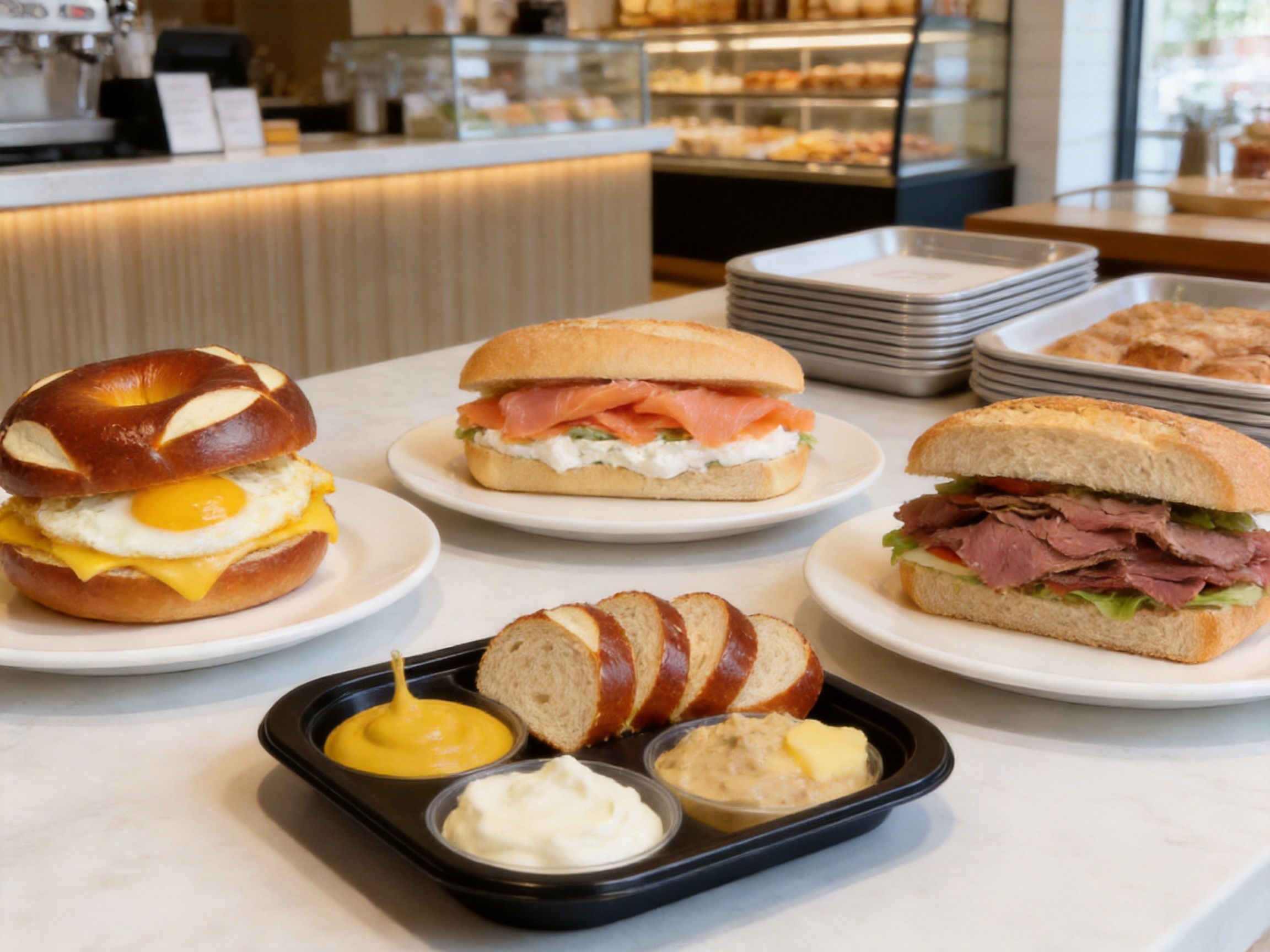
Menu concepts may include egg, cheese, and smoked meat; cream cheese with smoked fish; avocado with egg; or sausage with a savory sauce. The bagel can also be served simply with butter or spreadable cheese to highlight its toasted wheat flavor.
Café and Coffee Shop Programs
Cafés often need products that pair naturally with hot and cold beverages. The Pretzel Bagel works with coffee, tea, cocoa, and specialty drinks because its savory crust and wheat-forward interior provide a satisfying counterpoint to sweet beverages.
It can be offered as a whole product, sliced and toasted, or prepared as a filled sandwich. The glossy exterior also contributes to display appeal, which can be important for customers making quick purchasing decisions at the counter.
Lunch and Quick-Service Sandwiches
The product’s firm structure makes it suitable for lunch sandwiches. It can carry sliced proteins, cheese, lettuce, tomato, pickles, roasted vegetables, and sauces while retaining a clear bagel identity.
Because the crust already contributes flavor, operators may be able to build appealing sandwiches with relatively simple fillings. This can help control recipe complexity while still presenting a product with strong character.
Catering and Hospitality
For catering, the Pretzel Bagel can be sliced into smaller portions or used in assorted sandwich platters. Its darker crust creates visual contrast beside lighter breads, croissants, rolls, and wraps.
Hotels and hospitality operators can include it in breakfast buffets or grab-and-go selections. Its familiar bagel format makes it accessible to a broad audience, while its pretzel treatment gives the assortment additional variety.
Retail and Take-Home Consumption
In retail, the product can appeal to consumers who want a bakery item with a more distinctive crust. It can be sold as part of a frozen bagel assortment or incorporated into a premium own-brand range.
Clear preparation guidance and appropriate packaging can help consumers understand how to thaw, warm, or toast the product. The final preparation method should always follow validated manufacturer recommendations and local labeling requirements.
Menu Pairing Ideas
| Menu Direction | Suggested Pairings | Why It Works |
|---|---|---|
| Classic breakfast | Egg, cheddar, turkey sausage, and tomato | The savory crust complements familiar breakfast flavors |
| Premium café | Smoked salmon, cream cheese, cucumber, and herbs | The wheat-forward bagel balances fresh and rich ingredients |
| Lunch sandwich | Roast beef, Swiss cheese, greens, and mustard | The firm structure supports substantial fillings |
| Vegetarian option | Grilled vegetables, hummus, feta, and leafy greens | The pretzel flavor adds depth to plant-based fillings |
| Sweet and savory | Honey butter, roasted apple, and soft cheese | Sweet ingredients create contrast with the lightly salty crust |
| Snack platter | Small pieces with mustard, cheese dip, or hummus | The product can be portioned for sharing and grazing occasions |
Why the Product Supports Premium Positioning
Premium positioning requires more than a higher price. Customers need to see and taste a reason to choose one product over another. The Pretzel Bagel offers several visible and sensory signals of value: a glossy dark crust, a specialized lye-bath process, high-temperature baking, roasted aroma, and a more complex eating experience.
The product also communicates craftsmanship. Although it is manufactured at commercial scale, the surface treatment and baking method are associated with traditional bakery skill. This allows operators to present the product as carefully made rather than merely standardized.
Premium positioning can be expressed through menu language, display placement, pairing choices, packaging, and serving temperature. A café may feature the bagel in a signature sandwich. A retailer may place it within a specialty bakery collection. A caterer may use it to add contrast to a mixed bread assortment.
Importantly, premium appeal should be supported by operational reliability. If the product looks distinctive but is difficult to store, prepare, or serve consistently, its value may be reduced. The combination of specialized processing and commercial practicality gives this product a stronger foundation for premium programs.
Food Safety and Process Responsibility
Professional handling is essential throughout the production of a pretzel-style bakery product. The lye bath must be managed by trained personnel using appropriate protective equipment, controlled procedures, and documented safety practices. The process should never be imitated casually or transferred to an uncontrolled environment.
After treatment and baking, the finished product must be handled in accordance with applicable food-safety requirements. This includes appropriate cooling, freezing, packaging, storage, transportation, and preparation controls. Commercial customers should follow the manufacturer’s technical documentation and local regulations.
Food safety also includes allergen communication and labeling. Buyers should obtain complete product documentation before placing the product on the market, including ingredient information, allergen declarations, nutritional data where required, storage instructions, and preparation guidance.
A reliable manufacturer supports customers by maintaining clear specifications and consistent production procedures. These systems help buyers evaluate the product correctly and integrate it into their own quality-management programs.
Supply Chain and Distribution Capability
A strong supply chain is essential for frozen bakery products. Raw material availability, production scheduling, finished-goods storage, order coordination, and transportation all influence the buyer’s experience.
Jiangsu Goobagel Food Technology Co., Ltd. operates an integrated supply chain covering raw materials, R&D, production, and nationwide distribution. This structure supports closer coordination between technical development and commercial delivery.
For international or large-scale buyers, supply-chain strength can be an important selection factor. A product may be attractive in a sample evaluation, but long-term success depends on reliable replenishment, stable specifications, responsive communication, and the ability to support changing demand.
The company’s experience with retail, foodservice, café chains, tea brands, and bakery operators demonstrates familiarity with different purchasing and distribution environments. This background can help support projects that require more than a single shipment of finished goods.
Choosing the Right Product for Different Markets
Market selection should consider the desired consumer experience, preparation environment, price position, and sales channel. The Pretzel Bagel is particularly suitable for customers who value visible differentiation and flexible use.
In a premium café, the product can become a signature sandwich base. In a supermarket, it can serve as a specialty frozen bagel. In a hotel, it can broaden the breakfast bakery assortment. In a bakery or deli, it can be toasted and filled to order.
For distributors, the product may appeal to customers looking for a middle ground between ordinary bagels and traditional pretzels. Its format is familiar, but its crust and baking profile offer a more distinctive selling point.
For private-label buyers, the product can be positioned around craftsmanship, toasted flavor, high-temperature baking, or modern café culture. Packaging and marketing claims should always be based on verified product data and comply with the regulations of the target market.
Quality Evaluation Criteria for Buyers
When evaluating a pretzel bagel, buyers should consider more than surface color. A complete assessment should include appearance, aroma, crust structure, crumb texture, flavor, size consistency, preparation performance, and storage stability.
The surface should present an attractive, even brown color with a suitable sheen. The crust should be lightly crisp and resilient rather than excessively hard. The interior should show a stable crumb structure with enough elasticity for sandwich use.
Aroma should reflect baked wheat and savory pretzel character without undesirable burnt or chemical notes. Flavor should be balanced, with the alkaline process supporting the product rather than overwhelming it.
Buyers should also evaluate the product after the intended preparation method. A bagel may perform differently when thawed, warmed, toasted, or used in a sandwich. Testing the product in realistic service conditions can reveal whether it meets the needs of the target menu.
Finally, buyers should examine documentation, packaging, case configuration, minimum order requirements, lead times, and technical support. Product quality and commercial practicality should be evaluated together.
Environmental and Operational Considerations
Commercial bakery buyers increasingly consider efficiency alongside product quality. A frozen product can support more controlled production planning and may help reduce some forms of daily preparation waste when inventory is managed correctly.
Portion consistency also supports efficient recipe planning. The 100-gram format gives operators a clear foundation for calculating ingredient use and designing standardized menu builds.
Packaging decisions, storage efficiency, transportation planning, and stock rotation remain important. Buyers should work with the manufacturer and logistics partners to determine suitable case quantities, storage requirements, and ordering schedules.
Operational efficiency should not compromise safety or quality. The correct approach is to align preparation procedures, staff training, storage controls, and demand forecasting so that the product reaches consumers in the intended condition.
Frequently Asked Questions
What is the High-Temperature Baking Pretzel Bagel?
It is a 100-gram bagel with a pretzel-style crust created through a lye bath of more than 30 seconds followed by high-temperature baking. It combines a glossy brown exterior with a lightly crisp crust and resilient, wheat-forward interior.
How does the product differ from a standard plain bagel?
The main differences are the alkaline surface treatment, deeper brown color, glossy appearance, savory pretzel aroma, and more pronounced crust character. It remains flexible enough for the same general uses as a conventional bagel.
Why is the lye bath important?
The lye bath helps prepare the dough surface for browning and crust development. It contributes to the distinctive pretzel appearance, aroma, and flavor that distinguish the product from ordinary bagels.
What does high-temperature baking contribute?
High-temperature baking supports deeper browning and Maillard reaction development. This helps create a more complex toasted aroma, a darker glossy crust, and a stronger baked flavor.
Is the crust hard like a dry pretzel?
No. The product is designed to provide a lightly crisp but resilient crust. The intended eating experience includes a clean initial bite followed by a chewy, elastic interior rather than an excessively hard shell.
What fillings work well with this bagel?
It pairs well with cream cheese, eggs, cheese, smoked salmon, poultry, beef, bacon, roasted vegetables, hummus, avocado, mustard, honey butter, and other sweet or savory ingredients.
Can it be used for sandwiches?
Yes. Its substantial interior and stable round format make it suitable for breakfast sandwiches, lunch sandwiches, catering portions, and grab-and-go products.
Who manufactures the product?
The product is manufactured by Jiangsu Goobagel Food Technology Co., Ltd., a frozen bakery producer specializing in bagel research, development, manufacturing, and distribution.
Does the manufacturer offer OEM or private-label cooperation?
The company provides OEM and private-label bagel solutions for commercial customers. Specific options, packaging formats, specifications, order quantities, and development conditions should be confirmed directly during project discussion.
What types of businesses can use this product?
Potential users include cafés, restaurant groups, hotels, catering companies, supermarkets, bakery distributors, foodservice operators, tea brands, convenience channels, and private-label retailers.
How should buyers evaluate the product before ordering?
Buyers should conduct a sample evaluation that includes appearance, aroma, crust, crumb, flavor, reheating performance, sandwich performance, storage requirements, documentation, and suitability for the intended sales channel.
Is the lye process suitable for small-scale untrained preparation?
No. Lye is caustic and must be managed by trained personnel using professional safety procedures. The process should be carried out in a controlled manufacturing environment.
Conclusion
The High-Temperature Baking Pretzel Bagel offers a strong combination of visual impact, distinctive flavor, flexible application, and commercial consistency. Its glossy brown crust is created through a carefully controlled lye bath and high-temperature baking process, while its interior maintains the chewy and wheat-forward character expected from a quality bagel.
Compared with ordinary bagels, it provides stronger differentiation, deeper aroma, and a more premium appearance. Compared with conventional pretzels, it offers a more flexible sandwich-friendly format that can be integrated into existing bagel menus and preparation systems.
Its value is further supported by the manufacturing capabilities of Jiangsu Goobagel Food Technology Co., Ltd. The company’s experience in bagel research, clean-label product development, integrated supply-chain management, and commercial distribution makes it a suitable partner for retail, foodservice, café, bakery, and private-label projects.
For businesses seeking a signature bakery item that is recognizable, adaptable, and operationally practical, the Pretzel Bagel provides a compelling platform. It can anchor a breakfast menu, strengthen a café offering, add variety to a retail assortment, or become the base for a branded sandwich program. With appropriate handling and a well-planned commercial application, it offers the sensory appeal of a premium pretzel and the versatility of a dependable bagel.
References
1. Jiangsu Goobagel Food Technology Co., Ltd. Product information and manufacturing profile for the High-Temperature Baking Pretzel Bagel.
2. Jiangsu Goobagel Food Technology Co., Ltd. Company information concerning bagel research, clean-label product development, frozen bakery manufacturing, and commercial distribution.
3. Association of Operative Millers. General technical literature on wheat flour functionality and baked grain characteristics.
4. American Institute of Baking. Technical references on bakery processing, dough handling, baking control, and finished-product quality.
5. Professional baking literature concerning alkaline treatment, pretzel crust formation, Maillard reaction development, and commercial bakery process control.
6. General food-service guidance concerning frozen bakery storage, preparation procedures, allergen communication, and food-safety management.
