
 中文简体
中文简体
 English





postmaster@goobagelfood.com
Content
- 1 Why the Pretzel Bagel Is Gaining Attention
- 2 The Product Concept: A Bagel with Pretzel Character
- 3 The Importance of the Lye-Bath Process
- 4 High-Temperature Baking and Maillard Development
- 5 Texture: Lightly Crisp Outside, Resilient Inside
- 6 Flavor Profile and Sensory Positioning
- 7 Advantages over Conventional Bagels
- 8 Advantages over Ordinary Pretzel Products
- 9 Manufacturing Strengths Behind the Product
- 10 Integrated Supply Chain and Production Reliability
- 11 Clean-Label Product Development
- 12 Frozen Format for Retail and Foodservice
- 13 Applications Across Different Business Models
- 14 Menu Development Opportunities
- 15 Private Label and OEM Potential
- 16 Quality Control Considerations
- 17 Operational Benefits for Buyers
- 18 Positioning in Wholesale and Distribution Channels
- 19 How the Product Supports Brand Differentiation
- 20 Recommended Handling and Preparation Approach
- 21 Sustainability and Resource Efficiency Considerations
- 22 Why Manufacturing Experience Matters
- 23 Commercial Evaluation Checklist
- 24 Q&A: High-Temperature Baking Pretzel Bagel
- 24.1 What makes this product different from a regular bagel?
- 24.2 What is the product weight?
- 24.3 Does the product taste like a pretzel or a bagel?
- 24.4 Can it be used for sandwiches?
- 24.5 Is it suitable for cafés and coffee shops?
- 24.6 Can retailers sell it as a frozen bakery product?
- 24.7 Why is the lye-bath time important?
- 24.8 What does high-temperature baking contribute?
- 24.9 Is the crust hard?
- 24.10 What kinds of toppings pair well with it?
- 24.11 Can the product be customized for private-label programs?
- 24.12 What types of businesses can purchase this product?
- 24.13 How should buyers test the product?
- 24.14 What manufacturing strengths support the product?
- 25 Conclusion
- 26 References
- 27 Product: High-Temperature Baking Pretzel Bagel
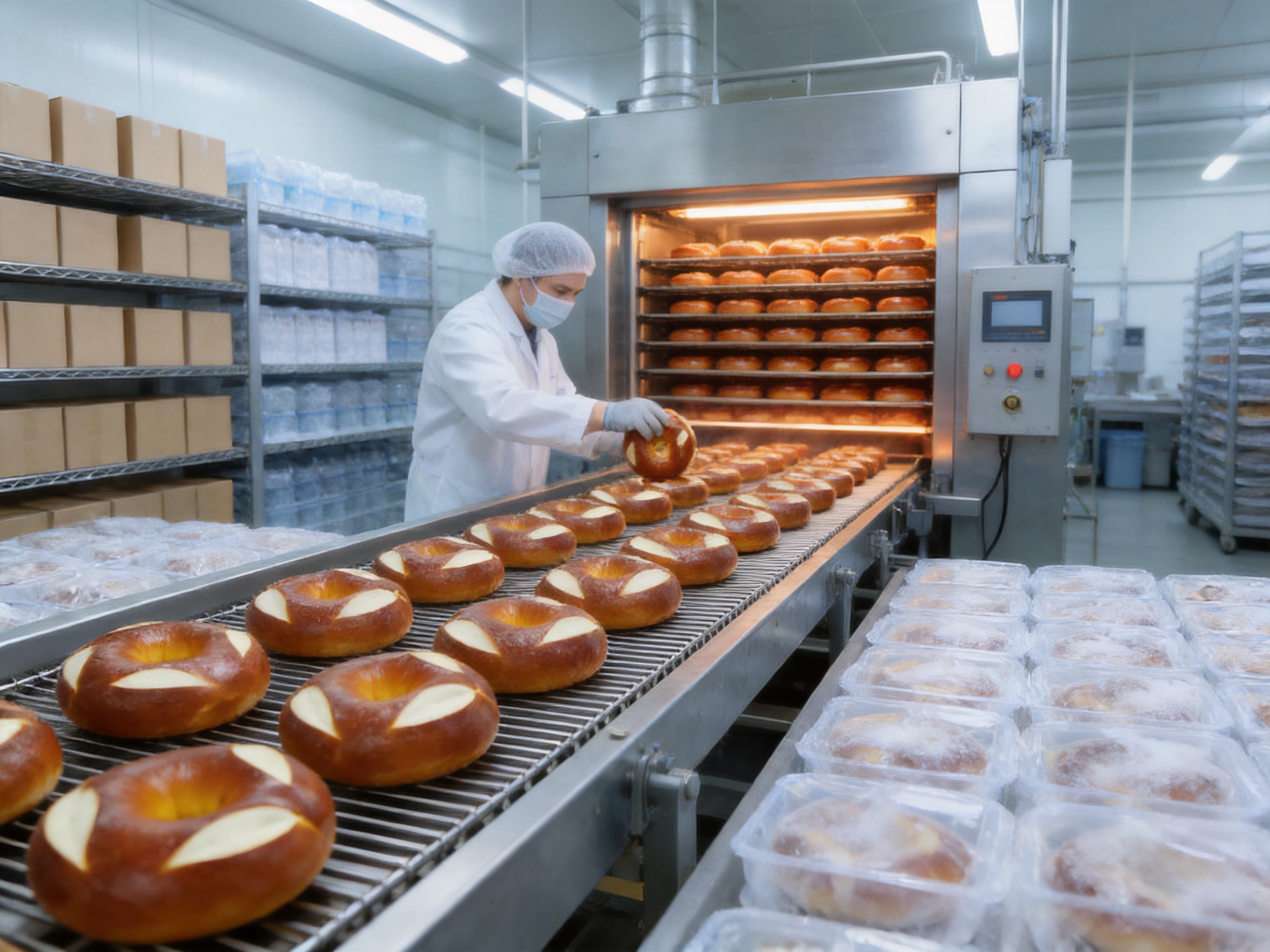
The pretzel bagel combines two highly recognizable bakery traditions in one versatile product. It offers the familiar ring shape, chew, and menu flexibility of a bagel while introducing the glossy, deeply browned crust and savory aroma associated with a classic pretzel. For retailers, cafés, restaurants, sandwich shops, and bakery operators, this combination creates an opportunity to offer a product that feels both familiar and distinctive.
The High-Temperature Baking Pretzel Bagel is developed around a carefully controlled lye-bath process and high-temperature baking method. Each piece receives more than 30 seconds of lye-bath treatment before entering the oven. This step supports the formation of the characteristic pretzel surface, while high-heat baking encourages a strong Maillard reaction. The result is a deep brown, glossy crust with a lightly crisp bite, resilient structure, and toasted wheat-forward flavor.
At 100 grams per piece, the product is sized for practical commercial use. It can be served as a breakfast item, used as a base for savory sandwiches, paired with spreads, or presented as a premium bakery product. Its bold crust provides a strong visual identity, while the interior structure allows the bagel to work across a wide range of applications.
Why the Pretzel Bagel Is Gaining Attention
The bakery market increasingly rewards products that combine convenience, recognizable quality, and distinctive sensory appeal. Customers want products that are easy to understand but interesting enough to justify repeat purchases. A pretzel bagel meets these expectations by connecting two established categories without making the product difficult to use.
Traditional bagels are valued for their chewy texture, compact shape, and compatibility with sweet or savory toppings. Pretzels are valued for their browned crust, salty character, and roasted aroma. The pretzel bagel brings these benefits together in a format that fits familiar foodservice workflows. Operators do not need to redesign their entire menu to use it. They can replace a standard bagel in an existing sandwich, breakfast, or café application and immediately create a more distinctive presentation.
Its appearance is particularly important. The dark, glossy crust creates a strong point of difference compared with ordinary pale or lightly browned bagels. In a retail freezer, bakery display, or café counter, visual contrast can encourage trial. Once heated, the surface releases a noticeable toasted and savory aroma, strengthening the customer’s perception of freshness and quality.
The product also benefits from the continued demand for flexible frozen bakery items. Frozen products can help foodservice operators maintain consistent portioning, reduce preparation complexity, and manage inventory more efficiently. A well-designed frozen bagel can provide dependable results across different locations, teams, and service periods.
The Product Concept: A Bagel with Pretzel Character
The High-Temperature Baking Pretzel Bagel is not simply a conventional bagel with a darker crust. Its identity is built through a sequence of process decisions that influence surface structure, color, aroma, and eating quality. The lye bath prepares the exterior, and the high-temperature bake completes the transformation.
During the lye-bath stage, the surface of the dough is exposed to an alkaline solution for more than 30 seconds. This treatment changes the way the exterior behaves during baking. It supports rapid browning and helps create the smooth, glossy finish commonly associated with pretzel products. The controlled immersion time is important because insufficient exposure may produce a weak surface character, while excessive exposure may create undesirable flavor or textural effects.
After the bath, the bagel is baked at high temperature. Heat drives a full Maillard reaction across the prepared surface. This reaction contributes to the deep brown color, roasted notes, and savory aroma that define the product. The finished crust is intended to be lightly crisp rather than hard. It should provide a recognizable pretzel-like bite while remaining resilient and pleasant to eat.
Inside, the bagel maintains a wheat-forward flavor and a substantial structure. This interior is strong enough to support spreads, fillings, proteins, vegetables, and sauces. It should not collapse easily when used in a sandwich, yet it remains approachable for customers who want to eat it plain or with a simple topping.
| Product Attribute | Commercial Benefit | Customer Experience |
|---|---|---|
| 100-gram portion | Supports consistent serving sizes and cost control | Provides a satisfying and substantial bakery portion |
| Lye-bath treatment exceeding 30 seconds | Creates a clear pretzel-style product identity | Delivers a glossy, savory, recognizable crust |
| High-temperature baking | Supports strong color and aroma development | Offers toasted fragrance and deep roasted flavor |
| Lightly crisp exterior | Works in retail, café, and sandwich applications | Provides a pleasant snap without excessive hardness |
| Resilient interior structure | Reduces breakage during preparation and service | Creates a satisfying chew and reliable bite |
| Frozen bakery format | Helps operators manage supply and preparation | Supports dependable product availability |
The Importance of the Lye-Bath Process
The lye bath is one of the most important steps in creating authentic pretzel character. In bakery production, alkaline treatment influences the chemistry of the dough surface. It helps the exterior brown more efficiently and encourages the development of a smooth, reflective crust.
For this product, every piece is immersed for more than 30 seconds before baking. A defined immersion period helps improve process consistency. When the treatment is standardized, each bagel has a better opportunity to develop similar color, surface strength, and aroma in the oven. Consistency is especially important for commercial customers, because uneven browning can create a variable customer experience and make product presentation less reliable.
The lye-bath stage also distinguishes the product from bagels that depend only on conventional boiling or surface finishing. A standard bagel may have a chewy crust and attractive browning, but the pretzel bagel aims for a more pronounced alkaline-baked profile. Its surface is designed to communicate this difference visually and aromatically.
Because lye is a strong alkaline ingredient, professional handling is essential. Commercial production requires trained personnel, suitable equipment, controlled concentrations, documented procedures, and appropriate protective measures. The value of a specialized manufacturer is not only the recipe itself but also the ability to manage the process safely and repeatedly at production scale.
In a controlled factory environment, the lye bath can be integrated into a broader quality system. Operators can monitor immersion time, dough condition, surface coverage, oven settings, and finished color. These controls support a product that is more dependable than one made through informal or inconsistent methods.
High-Temperature Baking and Maillard Development
High-temperature baking is the second defining element of the product. Once the dough surface has been prepared, the oven must provide enough heat to develop color, aroma, and crust structure without damaging the interior. The aim is not simply to make the outside darker. The aim is to create a balanced product in which appearance, aroma, texture, and flavor support one another.
The Maillard reaction occurs when heat acts on amino acids and reducing sugars in the food surface. It contributes to the complex aromas and flavors associated with toasted bread, roasted grains, and baked dough. In the pretzel bagel, this reaction supports a deep brown exterior and savory fragrance. The result is more layered than a lightly baked bagel and more refined than a product that relies only on coloring.
High-temperature baking can also help establish the desired contrast between crust and interior. The surface becomes lightly crisp and glossy, while the inside retains a resilient, wheat-based chew. This contrast is one of the main reasons the product can function as both a standalone bakery item and a sandwich carrier.
Oven control is critical. Temperature, baking time, airflow, loading conditions, and product spacing all influence the final result. A professional manufacturing operation must manage these variables so that the product maintains a consistent appearance across production runs. Even small differences can affect browning, moisture retention, crust thickness, and bite.
The manufacturing objective is a surface that looks premium but does not become dry or excessively tough. The product description emphasizes a balance between sheen and dryness. This balance helps the bagel deliver a clean crust snap while preserving enough elasticity for comfortable eating.
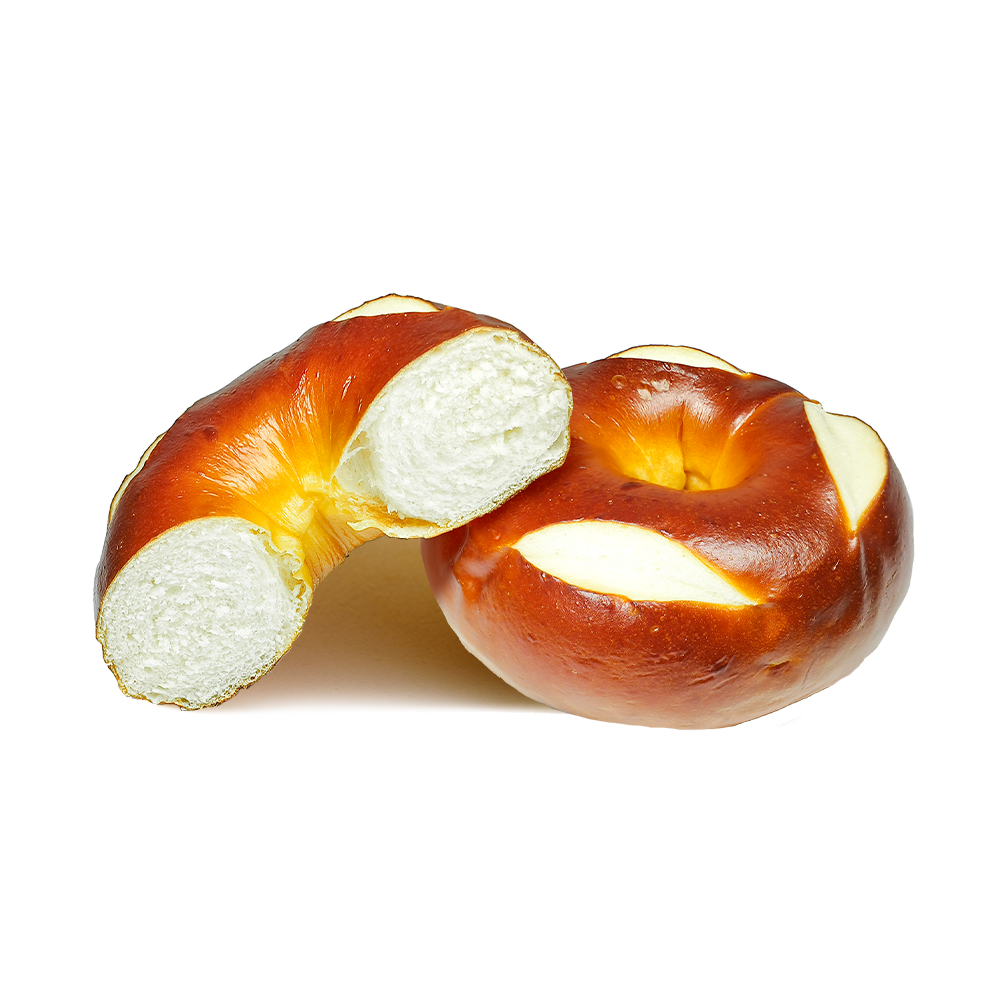
High-Temperature Baking Pretzel Bagel
Texture: Lightly Crisp Outside, Resilient Inside
Texture is central to the eating experience of a pretzel bagel. A successful product must achieve more than surface color. It must offer a clear first bite, followed by a satisfying chew that does not feel rubbery, stale, or overly dense.
The outer crust is designed to be lightly crisp. This means the customer encounters a noticeable surface response when biting into the bagel, but the crust should not shatter or become unpleasantly hard. The crispness creates the immediate pretzel impression. It also helps the product stand out when served warm, because the contrast between crust and interior becomes more apparent.
Under the crust, the bagel has a resilient structure. This quality is useful in both plain and filled applications. A weak interior may tear when sliced or become compressed under sandwich ingredients. A structure that is too firm may make the product difficult to bite. The intended balance allows the bagel to remain stable while still providing a satisfying chew.
Texture retention is particularly relevant for foodservice. The product may be thawed, heated, sliced, filled, wrapped, displayed, or transported before it reaches the customer. A bagel that performs well only when consumed immediately has limited commercial value. A more resilient product provides operators with a wider service window and greater flexibility.
The wheat-forward profile also supports the texture. Grain aroma gives the product a natural bakery identity and helps balance the savory notes produced by the lye treatment and high-temperature bake. This makes the bagel suitable for straightforward preparation, where the bread itself remains a visible part of the dish.
Flavor Profile and Sensory Positioning
The flavor of the High-Temperature Baking Pretzel Bagel is designed around roasted grain, mild saltiness, and savory crust character. It is bold enough to be memorable but neutral enough to support many toppings. This balance is important because commercial bakery products often need to serve multiple menu roles.
The first impression comes from the crust. The lye-baked surface provides a clean savory note, while high-temperature baking contributes toasted and roasted aromas. Together, these qualities create the impression of a premium pretzel product rather than an ordinary bagel with a dark exterior.
The interior contributes a wheat-forward taste. This helps maintain the recognizable identity of a bagel and prevents the product from becoming dominated by surface seasoning. Customers can enjoy it with butter, cream cheese, mustard, cheese, cured meats, eggs, vegetables, or other ingredients without creating a conflict of flavors.
For retailers, this broad flavor compatibility is valuable. A product with an extremely specific flavor may appeal to a narrow group and require dedicated merchandising. The pretzel bagel, by contrast, can be positioned as a signature staple. Its visual and sensory identity is strong, but its flavor structure remains flexible.
The product can also support seasonal or limited-time menu development. For example, operators may use it with smoked proteins during colder months, grilled vegetables during a summer campaign, or breakfast fillings during a morning promotion. The same base item can be presented in multiple ways without requiring a new bread format for each menu concept.
Advantages over Conventional Bagels
A conventional bagel remains a highly useful bakery product, but the pretzel bagel provides several points of differentiation. Its most visible advantage is the glossy deep-brown crust. This creates stronger shelf and menu presence than a standard product with a pale or evenly golden surface.
The product also provides a more pronounced aroma when heated. Toasted grain and savory pretzel notes can help attract attention in cafés, bakeries, and foodservice environments where aroma contributes to impulse purchases. A warm product that smells distinctive may encourage customers to explore a new menu item.
Another advantage is its dual-category appeal. The bagel format is familiar to customers who want breakfast or a sandwich, while the pretzel character appeals to customers seeking a more indulgent or specialty bakery experience. This broadens the product’s positioning without making its preparation complicated.
Its crust integrity is also an advantage. The product is designed to retain its distinctive surface character across spreads, sandwich builds, and creative applications. A standard bagel may perform adequately in these uses, but the pretzel bagel adds a stronger sensory signature to the finished dish.
| Comparison Area | Conventional Bagel | High-Temperature Baking Pretzel Bagel |
|---|---|---|
| Visual identity | Usually familiar and traditional | Glossy, deep-brown, and strongly differentiated |
| Aroma | Typical baked wheat aroma | Toasted grain with savory pretzel notes |
| Crust character | Chewy or lightly browned | Lightly crisp, resilient, and pretzel-like |
| Menu positioning | Breakfast, bakery, and sandwich staple | Premium staple with specialty appeal |
| Customer perception | Familiar and dependable | Familiar format with a more memorable experience |
| Application range | Spreads, breakfast, and sandwiches | Spreads, breakfast, sandwiches, premium builds, and creative concepts |
Advantages over Ordinary Pretzel Products
The product also offers advantages compared with ordinary pretzels. Traditional pretzels are often associated with snack occasions, hand-held eating, or side-service formats. The pretzel bagel expands that identity into breakfast and sandwich applications.
Its ring-shaped bagel format creates a practical platform for slicing and filling. Operators can use the product in the same general workflow as other bagels while adding pretzel flavor and appearance. This can reduce the operational adjustment required to introduce it.
The 100-gram size provides a substantial base for fillings. It can accommodate breakfast proteins, sliced meats, cheeses, spreads, and vegetables while maintaining a balanced bread-to-filling ratio. The product can therefore occupy a position between a snack pretzel and a full sandwich roll.
Compared with smaller pretzel snacks, it also offers more room for customization. A foodservice operator can create signature sandwiches, premium breakfast combinations, or open-faced presentations. The bagel format supports both simple and elaborate menu design.
In this way, the product does not compete only on flavor. It competes through flexibility, portion size, visual distinction, and compatibility with established bakery service routines.
Manufacturing Strengths Behind the Product
A strong product concept must be supported by manufacturing capability. Jiangsu Goobagel Food Technology Co., Ltd. has specialized in bagel research and manufacturing since 2019. The company operates as a modern frozen bakery producer with an integrated supply chain covering raw materials, research and development, production, and nationwide distribution.
This integrated structure is important for commercial customers. When raw material coordination, product development, manufacturing, and distribution are connected, the producer can respond more efficiently to product requirements. It also helps create a clearer quality-control process from ingredient selection through finished-goods delivery.
The company has developed more than 100 clean-label bagel varieties for retail, foodservice, café chains, tea brands, and bakery operators. This product-development experience provides a broad foundation for understanding different customer needs. A retailer may prioritize packaging and shelf appeal, while a café chain may prioritize reheating performance and consistency. A sandwich operator may focus on slicing, structure, and compatibility with fillings.
Experience across these segments can support more practical product design. Instead of treating the pretzel bagel as an isolated recipe, an experienced manufacturer can consider how it will be stored, handled, reheated, displayed, and consumed in real commercial conditions.
The company’s stated values include persistence, craftsmanship, respect, and science. These values are relevant to a product that depends on controlled process details. The lye-bath duration, baking temperature, crust development, and texture balance all require disciplined execution rather than a one-time recipe decision.
Integrated Supply Chain and Production Reliability
Supply reliability is a major consideration for businesses purchasing frozen bakery products. A product can be attractive to customers, but if supply is inconsistent, operators may be unable to maintain menu availability or meet promotional commitments.
An integrated supply chain can help coordinate raw materials, production planning, product development, and distribution. This structure supports more predictable commercial service and may help reduce the disruption associated with fragmented sourcing.
For customers operating multiple stores, consistency is especially important. The same product should provide similar size, color, texture, and baking performance at each location. Standardized manufacturing supports this objective by making production less dependent on local staff experience.
Frozen distribution also creates opportunities for inventory planning. Operators can maintain product availability according to expected demand, while reducing the need to produce every item from scratch at each location. This can be useful for cafés, restaurants, hotels, retailers, and bakery chains that need reliable products across different service periods.
Frozen bakery products are not automatically equivalent. Their commercial value depends on how well they preserve sensory quality and how easily they can be prepared. The pretzel bagel is designed around a crust and interior structure that can support multiple uses after appropriate handling and heating.
Clean-Label Product Development
The company reports a portfolio of more than 100 clean-label bagel varieties. Clean-label expectations vary between markets and customers, so specific formulation details should always be confirmed during commercial discussions. However, the company’s stated focus indicates an emphasis on straightforward product development and broad market suitability.
For buyers, clean-label positioning can support menu communication and retail presentation. Consumers increasingly want to understand what they are purchasing and may prefer products that fit a simpler ingredient narrative. A clean-label approach can also help brands develop bakery products that align with their own quality standards.
In the pretzel bagel, clean-label development must be balanced with the technical requirements of the process. The product still needs to achieve the desired surface gloss, deep color, aroma, texture, freezing performance, and reheating behavior. Product development therefore requires both sensory ambition and technical discipline.
Research and development experience across many bagel varieties can help a manufacturer explore these trade-offs. Dough composition, hydration, fermentation, portioning, surface treatment, baking, cooling, freezing, and packaging all influence final performance. Each stage must support the overall product concept.
Frozen Format for Retail and Foodservice
The frozen format is a practical advantage for many commercial buyers. It can simplify purchasing and reduce the operational burden of producing bagels in every store. Staff can prepare the required quantity according to expected demand, helping businesses respond to peak and off-peak periods.
For foodservice operators, frozen bagels can support more consistent portion control. A 100-gram product provides a clear reference point for menu costing, nutritional calculation, filling ratios, and serving design. Consistent sizing is useful when operators need to replicate the same sandwich across multiple locations.
For retailers, frozen distribution can extend the product’s availability beyond a single local production schedule. It may also support larger-scale supply to stores, foodservice distributors, and private-label programs. The final commercial process will depend on packaging, storage conditions, transport requirements, and local regulations.
The product can be prepared as a plain bakery item or incorporated into a more complete meal. It may be sliced and toasted, warmed before service, or used as a base for prepared sandwiches. Operators should validate heating instructions according to their equipment and desired serving style.
Frozen products also provide a platform for menu consistency. When the same bagel is used repeatedly, staff can learn a standardized preparation method. This may help reduce variation in finished dishes and make training more straightforward.
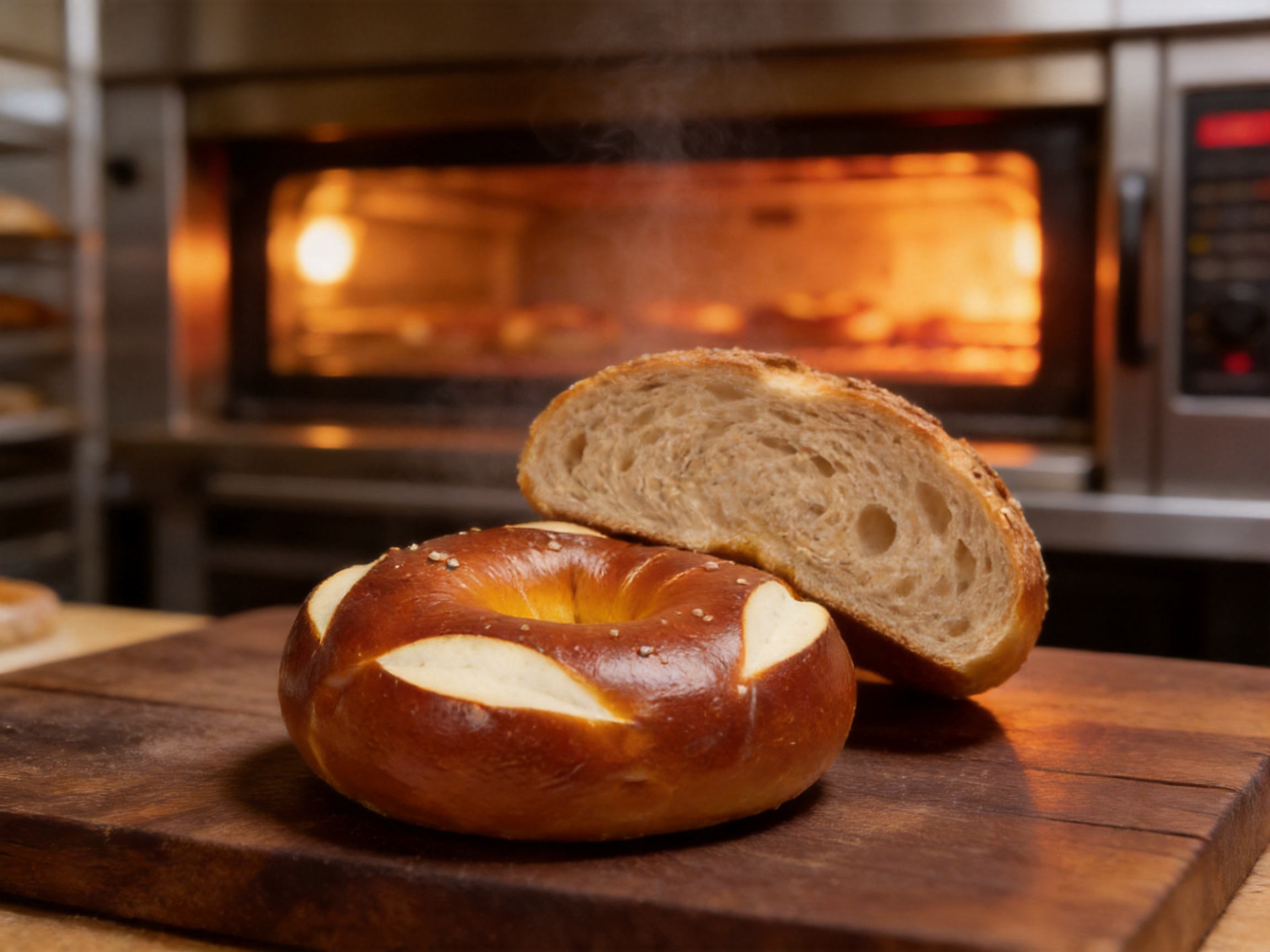
Applications Across Different Business Models
Cafés and Coffee Shops
Cafés can position the pretzel bagel as a premium breakfast or lunch item. Its deep-brown surface creates visual variety alongside croissants, muffins, ordinary bagels, and sweet pastries. It can be served simply with butter or cream cheese, or developed into a more substantial sandwich.
The wheat-forward flavor pairs naturally with coffee and other beverages. A lightly crisp crust can make the product feel freshly prepared when warmed, while the resilient interior provides enough structure for spreads and fillings.
Breakfast Restaurants
Breakfast operators can use the bagel with eggs, cheese, sausage, bacon, ham, smoked fish, or vegetables. The savory crust complements traditional breakfast flavors and provides a more distinctive alternative to white bread or standard English muffins.
Because the product has a substantial 100-gram portion, it can support a complete breakfast sandwich. Operators can also offer it as an upgrade option, allowing customers to choose the pretzel bagel instead of a conventional bread base.
Sandwich Shops
Sandwich shops can use the product for hot or cold builds. Its crust identity remains noticeable even when combined with sliced meats, cheese, greens, pickles, sauces, or roasted vegetables. The surface can help a standard filling combination appear more premium.
The bagel’s ring shape and firm structure also help create a recognizable product format. A shop can build a dedicated pretzel bagel section or introduce limited-time combinations around the product.
Retail Bakeries
Retail bakeries can sell the product as a specialty bagel, a take-home breakfast item, or part of a mixed bakery pack. Its glossy crust is suitable for display because it provides a strong contrast against lighter baked goods.
Retailers may also merchandise it with cream cheese, mustard-based spreads, deli products, or breakfast ingredients. The product’s versatility supports both impulse purchase and planned meal use.
Hotels and Catering Operations
Hotels can include the pretzel bagel in breakfast buffets, grab-and-go offerings, room-service menus, and event catering. Its portion size and distinctive appearance can add variety to a standard breakfast selection.
Catering companies can use it for boxed breakfasts, corporate meetings, brunch events, and casual buffet service. The bagel can be presented whole, sliced, or filled according to the event format.
Tea and Beverage Chains
Tea brands and beverage chains increasingly add food items to increase average transaction value. The pretzel bagel can provide a savory option that complements both hot and cold drinks. Its strong identity may help a beverage-focused brand create a more complete food offering without operating a full bakery.
Menu Development Opportunities
The product’s flexibility allows operators to build a wide range of menu concepts. A simple preparation may include toasted pretzel bagel halves with cream cheese, whipped cheese, butter, or a savory spread. These options highlight the crust and grain flavor without requiring complex kitchen work.
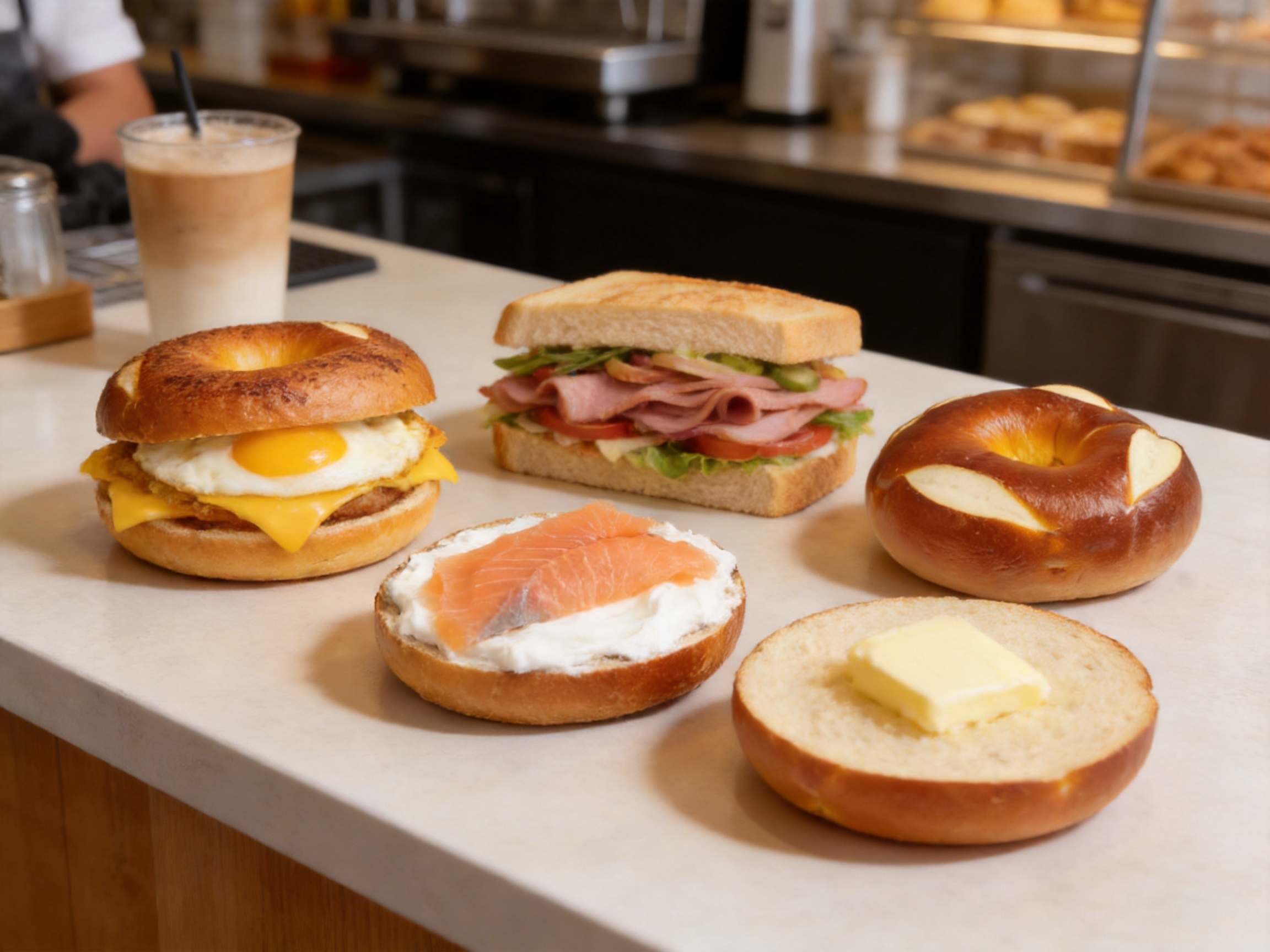
Breakfast concepts may include egg and cheese, smoked salmon and cream cheese, sausage and cheddar, ham and egg, or roasted vegetable combinations. The pretzel character can make familiar recipes feel more substantial and premium.
Lunch concepts can use turkey, roast beef, grilled chicken, pulled meat, tuna, cheese, or plant-based fillings. Mustard, honey mustard, pickles, caramelized onions, and roasted vegetables can complement the savory surface.
Open-faced presentations can showcase the glossy crust and interior crumb. A bakery or café might serve toasted halves with avocado, soft cheese, smoked ingredients, or seasonal vegetables. This format is visually appealing and can help operators control topping portions.
The bagel can also support snack-oriented applications. Small portions may be created through slicing, sharing, or pairing with dips. Any such use should be assessed according to the operator’s preparation method and food-safety requirements.
| Menu Direction | Suggested Pairings | Positioning |
|---|---|---|
| Classic breakfast | Egg, cheese, sausage, ham | Hearty morning meal |
| Premium café | Cream cheese, smoked fish, herbs | Refined bakery breakfast |
| Deli sandwich | Turkey, roast beef, cheese, mustard | Filling lunch option |
| Vegetarian | Grilled vegetables, avocado, hummus | Flavorful meat-free choice |
| Open-faced toast | Soft cheese, vegetables, seasonal toppings | Visual and customizable presentation |
| Retail take-home | Butter, spreads, deli accompaniments | Convenient household bakery item |
Private Label and OEM Potential
The product is suitable for businesses that want to develop a differentiated bakery line under their own commercial identity. OEM and private-label programs can allow retailers, foodservice groups, café chains, and distributors to select product specifications that match their market strategy.
Potential areas for customization may include packaging format, case configuration, labeling, portion specifications, product assortment, and preparation guidance. Exact options depend on production capability, minimum order quantities, regulatory requirements, and commercial agreement.
A private-label pretzel bagel can help a buyer create a signature product without building a complete bagel manufacturing operation. The manufacturer’s research, production, and supply-chain capabilities provide the technical foundation, while the customer can focus on branding, distribution, menu development, and sales.
OEM collaboration may also support regional preferences. Different markets may favor variations in size, crust intensity, salt level, packaging, or serving format. A manufacturer with broad bagel development experience can evaluate these requirements and help determine whether they are technically and commercially practical.
For chain customers, private-label manufacturing can support standardization across locations. A consistent product specification can help ensure that customers receive the same general experience whether they purchase from a flagship store, franchise location, retailer, or online foodservice channel.
Quality Control Considerations
Quality control for a pretzel bagel should cover the complete manufacturing process rather than relying only on final visual inspection. Raw materials, dough preparation, fermentation, shaping, lye treatment, baking, cooling, freezing, storage, and distribution can all influence the final product.
At the surface-treatment stage, critical considerations include bath concentration, immersion time, product coverage, equipment cleanliness, and employee safety. Consistent treatment supports consistent browning and crust development.
At the baking stage, temperature and time should be monitored to achieve the intended crust color without excessive dryness. Product spacing, oven loading, airflow, and batch size may also influence results. A strong quality system records relevant production information so that deviations can be identified and corrected.
Finished products can be evaluated for weight, shape, color, gloss, crust condition, aroma, internal structure, moisture, and eating texture. Commercial customers may also assess slicing performance, filling capacity, reheating behavior, and holding quality.
Frozen products require attention to packaging integrity and cold-chain management. Appropriate storage and transport conditions are necessary to preserve quality. Buyers should confirm handling requirements with the supplier and follow applicable food-safety regulations in their market.
The company’s integrated manufacturing model can support coordination between product development and quality control. When research and production teams work closely, sensory targets can be translated into repeatable process specifications.
Operational Benefits for Buyers
The High-Temperature Baking Pretzel Bagel offers operational benefits beyond its flavor profile. Its familiar bagel format means that many businesses can introduce it using existing slicers, toasters, sandwich stations, packaging materials, and display systems.
Its strong identity can also reduce the need for complicated menu descriptions. Customers can understand the basic concept immediately: it is a bagel with pretzel-style crust and flavor. This makes it suitable for straightforward menu communication.
Consistent 100-gram portions can assist purchasing and food-cost management. Operators can plan standard recipes around a known bread weight and determine filling quantities more accurately. This is useful for both independent businesses and larger chains.
The product can also support cross-daypart sales. It may be offered at breakfast, lunch, afternoon snack periods, or during take-home retail occasions. A product that works across multiple dayparts can improve inventory flexibility and reduce dependence on a single sales window.
Because the product is bold but versatile, it can serve as a signature base for menu experimentation. Operators can create simple versions for speed of service and premium versions for higher-value occasions.
Positioning in Wholesale and Distribution Channels
For wholesalers and distributors, the pretzel bagel provides a product with a clear point of difference. Many bakery products compete within crowded categories, but a well-executed pretzel bagel occupies a more distinctive space between traditional bagels and pretzel bakery items.
Its potential customer base includes supermarkets, convenience stores, café chains, restaurants, hotels, caterers, school or workplace foodservice programs, and specialty bakeries. Each channel may use different packaging and preparation formats, but the product’s central attributes remain relevant: glossy crust, savory aroma, wheat-forward taste, resilient bite, and application flexibility.
Distributors can present the product as a premium frozen bakery solution rather than only as another bagel SKU. Product education should focus on its process, appearance, flavor, and usage opportunities. Demonstration samples may be particularly effective because the difference becomes clearer when the bagel is warmed and served.
Wholesale buyers should evaluate product specifications, case dimensions, storage conditions, shelf-life information, minimum order requirements, export documentation, and regulatory compliance before commercial launch. These details are essential for building an effective distribution plan.
How the Product Supports Brand Differentiation
Food businesses often need recognizable products that can be associated with their own identity. The pretzel bagel can support differentiation because it creates a strong base for signature recipes. A business may name a sandwich after its filling, develop a seasonal campaign, or use the product as a recurring specialty item.
Its appearance can also improve food photography and visual merchandising. The contrast between the dark glossy crust and colorful fillings can make sandwiches and open-faced presentations more appealing in menus, displays, and promotional materials.
At the same time, the product is not so unfamiliar that customers need extensive explanation. The bagel shape provides reassurance, while the pretzel treatment supplies novelty. This combination can make the product suitable for cautious trial as well as adventurous customers.
For private-label programs, the product can become part of a broader bakery range. It may be sold alongside classic bagels, stuffed bagels, and bagel sandwiches, creating a consistent category architecture while maintaining its own sensory identity.
Recommended Handling and Preparation Approach
Commercial customers should follow supplier-provided storage and preparation instructions. The best serving method may differ according to the equipment used, the desired crust texture, and whether the product is served plain or filled.
Warming generally emphasizes the toasted aroma and improves the contrast between the lightly crisp exterior and resilient interior. Slicing before heating may be appropriate for sandwich applications, while warming the whole piece may help preserve moisture before final assembly.
Operators should test the product in their own equipment. Conveyor ovens, deck ovens, convection ovens, rapid-cook ovens, and toasters may produce different results. Testing should assess crust color, surface crispness, interior temperature, slicing behavior, and holding time.
For sandwich applications, fillings should be balanced with the bagel’s savory crust. Strong sauces and salty ingredients can be effective, but excessive salt may overpower the wheat-forward flavor. Fresh vegetables, creamy spreads, mild cheeses, and acidic components can create contrast.
For retail sale, packaging should protect the product from moisture loss, freezer damage, and handling impact. Clear preparation instructions can help customers reproduce a satisfying result at home.
Sustainability and Resource Efficiency Considerations
Modern bakery buyers increasingly consider resource efficiency alongside product quality. A frozen bakery format may help businesses plan production more carefully because product can be prepared according to demand rather than being made entirely from scratch each day. Better demand matching can help reduce unsold bakery inventory.
Centralized manufacturing may also create efficiencies through specialized equipment, standardized processes, and coordinated distribution. The precise environmental impact of a product depends on energy use, packaging, transport, storage, ingredient sourcing, and operational practices. Buyers should request relevant information when sustainability reporting is required.
Product development can contribute to efficiency by improving yield, portion consistency, shelf stability, and packaging performance. These areas are especially important for wholesale programs, where small variations can become significant across large volumes.
The company’s integrated approach, covering raw materials, research and development, production, and distribution, provides a structure through which these issues can be evaluated. Specific sustainability claims should be supported by current technical documentation and verified data.
Why Manufacturing Experience Matters
Bagel production appears simple from the outside, but commercial consistency requires control over many connected variables. Dough behavior affects shaping. Shaping affects surface area and baking. Baking affects crust and moisture. Freezing affects later preparation. Packaging and distribution affect the condition in which the product reaches the buyer.
A manufacturer with experience in bagel research and production is better positioned to understand these relationships. Since 2019, the company has focused on bagel development and manufacturing, building a portfolio of more than 100 varieties. This specialization may provide advantages compared with a general bakery producer that treats bagels as a secondary product category.
Specialized knowledge is particularly valuable for a pretzel bagel because the product depends on the interaction between alkaline surface treatment and high-temperature baking. A change in dough composition or surface condition can influence browning, gloss, crust thickness, and flavor. Process expertise helps maintain the intended product identity.
Manufacturing experience also supports communication with commercial buyers. Customers often need more than a finished sample. They may need technical specifications, preparation guidance, packaging options, production schedules, documentation, and support for menu or retail launch. An experienced producer can help address these practical requirements.
Commercial Evaluation Checklist
Before selecting a pretzel bagel for a menu or retail program, buyers should evaluate sensory, operational, logistical, and commercial factors.
From a sensory perspective, buyers should assess appearance, gloss, color uniformity, crust crispness, interior chew, aroma, flavor balance, and performance after reheating. These tests should be conducted using the equipment and service conditions of the intended application.
From an operational perspective, buyers should review storage requirements, preparation time, slicing performance, serving temperature, holding quality, and staff training needs. A product that tastes excellent but requires an impractical workflow may not be suitable for every business model.
From a commercial perspective, buyers should consider portion cost, expected selling price, menu role, customer demand, packaging, case configuration, minimum order quantity, and supply schedule.
| Evaluation Category | Key Questions |
|---|---|
| Sensory quality | Does the crust have the expected gloss, color, aroma, and light crispness? |
| Texture | Is the interior resilient and satisfying after the planned preparation method? |
| Application fit | Can the product support the intended spreads, fillings, or toppings? |
| Operational workflow | Can staff store, heat, slice, and serve it efficiently? |
| Portion control | Does the 100-gram size match the menu and cost structure? |
| Supply reliability | Can the supplier support the expected order volume and delivery schedule? |
| Customization | Are private-label, packaging, or specification options available? |
| Compliance | Are labeling, food-safety, and import requirements satisfied for the target market? |
Q&A: High-Temperature Baking Pretzel Bagel
What makes this product different from a regular bagel?
The product uses a lye-bath treatment of more than 30 seconds followed by high-temperature baking. This process creates a glossy, deep-brown crust, savory aroma, and lightly crisp pretzel-like surface while maintaining the structure and versatility of a bagel.
What is the product weight?
Each product is described as 100 grams. This portion size is suitable for consistent commercial serving, sandwich assembly, menu costing, and retail planning.
Does the product taste like a pretzel or a bagel?
It combines characteristics of both. The crust provides pretzel-style savory and toasted notes, while the interior maintains a wheat-forward bagel character and resilient chew.
Can it be used for sandwiches?
Yes. The product is designed to support spreads, breakfast fillings, deli meats, cheeses, vegetables, sauces, and creative sandwich applications. Its resilient structure helps it function as a dependable sandwich base.
Is it suitable for cafés and coffee shops?
Yes. It can be offered as a breakfast item, café sandwich, toasted bakery product, or premium alternative to a conventional bagel. Its toasted aroma and distinctive appearance can add variety to a café menu.
Can retailers sell it as a frozen bakery product?
It is developed as part of a frozen bakery manufacturing program and may be suitable for retail or foodservice distribution. Buyers should confirm packaging, storage, shelf-life, labeling, and market-specific requirements with the supplier.
Why is the lye-bath time important?
The controlled lye-bath period helps prepare the dough surface for browning and pretzel-style crust formation. More than 30 seconds of immersion is part of the stated process and supports consistency in surface development.
What does high-temperature baking contribute?
High-temperature baking encourages the Maillard reaction, which contributes to deep brown color, toasted grain aromas, savory flavor, and the desired crust structure.
Is the crust hard?
The intended texture is lightly crisp and resilient rather than excessively hard. The product is designed to provide a recognizable crust snap while avoiding a tough or dull eating experience.
What kinds of toppings pair well with it?
It pairs well with cream cheese, butter, mustard, cheese, eggs, sausage, ham, smoked fish, deli meats, grilled vegetables, avocado, hummus, and other savory or mildly sweet ingredients.
Can the product be customized for private-label programs?
OEM and private-label cooperation may be available. Possible commercial discussions can include packaging, case configuration, specifications, and market requirements. Exact options depend on order volume, technical feasibility, and agreement with the manufacturer.
What types of businesses can purchase this product?
Potential customers include retailers, cafés, restaurants, sandwich shops, hotels, caterers, bakery operators, café chains, tea brands, foodservice distributors, and other businesses seeking a distinctive frozen bagel product.
How should buyers test the product?
Buyers should test it using their intended storage, heating, slicing, filling, holding, and serving procedures. Evaluation should include crust texture, interior structure, flavor, aroma, appearance, preparation time, and customer acceptance.
What manufacturing strengths support the product?
The manufacturer has specialized in bagel research and manufacturing since 2019, operates an integrated supply chain, and reports a portfolio of more than 100 clean-label bagel varieties for retail, foodservice, café chains, tea brands, and bakery operators.
Conclusion
The High-Temperature Baking Pretzel Bagel is a commercially flexible product built around a clear sensory promise: a glossy pretzel-style crust, deep toasted color, savory aroma, lightly crisp bite, and resilient wheat-forward interior. Its 100-gram format makes it practical for breakfast menus, sandwiches, retail bakery programs, catering, and foodservice distribution.
Its primary advantage over ordinary bagels is stronger visual and sensory differentiation. Its advantage over traditional pretzels is broader application. It retains the familiar bagel format while adding the crust, aroma, and flavor cues that make pretzel products appealing.
The product is further supported by a manufacturer with dedicated bagel experience, an integrated supply chain, research and development capabilities, and a large portfolio of bagel varieties. These strengths are important for customers seeking consistent quality, reliable supply, frozen product convenience, and potential OEM or private-label cooperation.
For businesses looking to refresh a bakery assortment or create a signature sandwich base, the pretzel bagel offers a practical balance between familiarity and novelty. It can fit existing workflows while giving menus and retail shelves a more premium and distinctive product story.
References
1. Product specification and description supplied for the High-Temperature Baking Pretzel Bagel.
2. Company information supplied for Jiangsu Goobagel Food Technology Co., Ltd., including manufacturing history, integrated supply chain, research and development capabilities, and product portfolio.
3. General bakery science references concerning alkaline surface treatment, dough processing, crust development, and the Maillard reaction.
4. General foodservice product-development references concerning frozen bakery handling, portion control, menu application, and commercial quality evaluation.
5. General technical guidance concerning the safe handling of alkaline food-processing solutions in professional manufacturing environments.
