
 中文简体
 English





postmaster@goobagelfood.com
Content
- 1 What Makes a Pretzel Bagel Different?
- 2 The Role of the Alkaline Bath
- 3 High-Temperature Baking and Maillard Development
- 4 A Carefully Balanced Crust and Interior
- 5 Product Advantages Compared with Standard Bagel Options
- 6 Product Advantages Compared with Conventional Soft Pretzels
- 7 Manufacturing Strengths Behind the Product
- 8 Integrated Research and Development
- 9 Commercial Applications
- 10 Menu Ideas for the Pretzel Bagel
- 11 Frozen Bakery Performance
- 12 Consistency as a Competitive Advantage
- 13 Private Label and OEM Potential
- 14 Quality and Process Considerations
- 15 Why the Product Stands Out in a Crowded Market
- 16 Serving and Preparation Recommendations
- 17 Brand and Menu Positioning
- 18 Company Capabilities and Partnership Value
- 19 Frequently Asked Questions
- 19.1 What is a High-Temperature Baking Pretzel Bagel?
- 19.2 How does the alkaline bath affect the product?
- 19.3 How is this product different from a plain bagel?
- 19.4 How is it different from a soft pretzel?
- 19.5 Can it be used for sandwiches?
- 19.6 What types of businesses can use this product?
- 19.7 Why is the high-temperature baking process important?
- 19.8 Is the product suitable for frozen distribution?
- 19.9 Can the product be used in private-label programs?
- 19.10 What makes the manufacturer suitable for commercial cooperation?
- 20 Conclusion
- 21 References
- 22 Product: High-Temperature Baking Pretzel Bagel
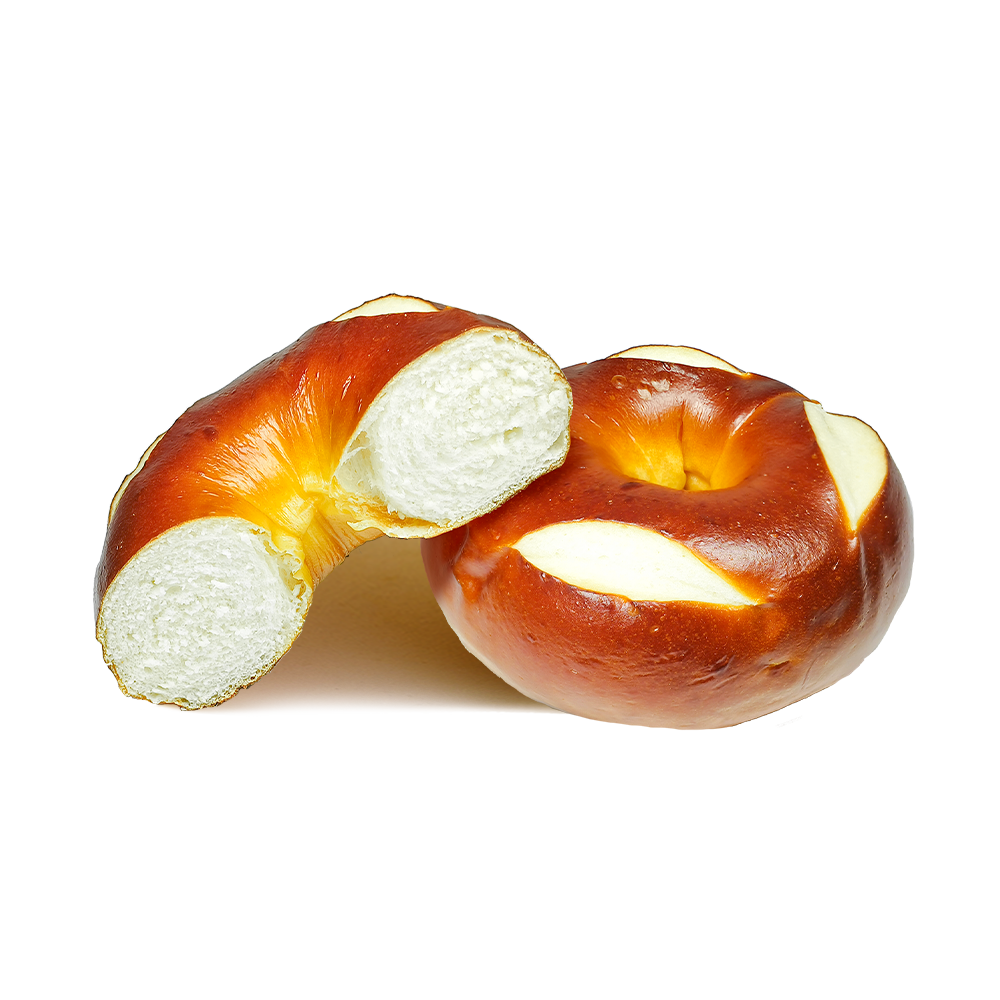
The High-Temperature Baking Pretzel Bagel combines the familiar shape and versatility of a traditional bagel with the deep color, savory aroma, and lightly crisp crust associated with a classic pretzel. Designed for commercial foodservice, retail, café, bakery, and private-label applications, it gives operators a distinctive product that can function as a breakfast staple, sandwich foundation, snack, or signature menu item.
Its defining character comes from a carefully controlled alkaline bath followed by high-temperature baking. Each piece is immersed in a lye bath for more than 30 seconds before entering the oven. This step helps create the characteristic pretzel-style surface structure. High-heat baking then encourages browning and the development of a glossy, deep-brown crust with a toasted wheat aroma. The result is a bagel with a clear visual identity and a flavor profile that stands apart from ordinary plain bagels.
For buyers seeking a reliable frozen bagel product, appearance is only one part of the decision. Commercial value also depends on consistency, handling, rethermalization performance, portion control, application flexibility, and supply reliability. The High-Temperature Baking Pretzel Bagel is developed around these requirements. It offers a recognizable eating experience while remaining suitable for spreads, sandwich builds, retail packs, café menus, and creative foodservice applications.
Manufactured by Jiangsu Goobagel Food Technology Co., Ltd., the product reflects the strengths of an integrated frozen bakery producer with capabilities spanning raw-material management, research and development, production, and distribution. Since 2019, the company has focused on bagel research and manufacturing, developing more than 100 clean-label bagel varieties for retail, foodservice, café chains, tea brands, and bakery operators.
High-Temperature Baking Pretzel Bagel
What Makes a Pretzel Bagel Different?
A traditional bagel is usually recognized for its dense, chewy interior and smooth, lightly browned exterior. A pretzel bagel retains the core appeal of a bagel but introduces a different surface experience. The alkaline treatment contributes to a darker crust, a more pronounced sheen, and a savory flavor impression. The crust is not simply decorative; it changes the first bite and gives the product a stronger identity in a crowded bakery category.
The High-Temperature Baking Pretzel Bagel is designed around contrast. Its outer layer provides a lightly crisp and resilient bite, while the interior supports the substantial, wheat-forward texture expected from a bagel. The surface offers a clean salty-savory snap before opening into toasted grain notes. This contrast helps the product remain satisfying when served by itself, with a spread, or as part of a more complete meal.
The visual difference is equally important. A glossy brown crust can communicate premium quality at the point of sale, especially when the product is displayed in a bakery case, café basket, sandwich counter, or retail package. Color and surface sheen help customers recognize the product before tasting it. For operators, this can make the bagel easier to position as a signature item rather than another interchangeable bread product.
Compared with a standard plain bagel, a pretzel-style bagel has a more distinctive flavor cue. Compared with a conventional soft pretzel, it offers the familiar round format, interior structure, and menu flexibility of a bagel. This middle position creates opportunities for businesses that want a product with a strong personality without limiting it to one serving occasion.
The Role of the Alkaline Bath
The alkaline bath is central to the product’s identity. Each piece is immersed for more than 30 seconds before baking, allowing the surface to undergo the treatment necessary for a pretzel-style crust. The duration of immersion must be managed carefully. Too little exposure may produce a weaker surface character, while excessive or inconsistent treatment can affect appearance, flavor, or texture.
A controlled bath helps establish a more uniform foundation for baking. Surface preparation influences how the crust develops under high heat, including its color, firmness, sheen, and aromatic profile. In a commercial production environment, this stage requires repeatable procedures, suitable equipment, and trained process control. Consistency is especially important for frozen bakery products because customers expect the same appearance and eating quality from one batch to the next.
The use of an alkaline treatment also distinguishes the product from ordinary boiled or steamed bagels. The surface chemistry encourages a deeper browning response during baking and supports the characteristic pretzel aroma. This does not mean the bagel becomes a conventional pretzel. Instead, it combines pretzel-inspired crust qualities with a bagel’s shape, density, and application range.
For food manufacturers and distributors, process differentiation is a practical advantage. A product with a clear technical story is easier to communicate to buyers, menu developers, and consumers. The more recognizable the production method, the easier it becomes to explain why the product looks and tastes different from a standard bagel.
High-Temperature Baking and Maillard Development
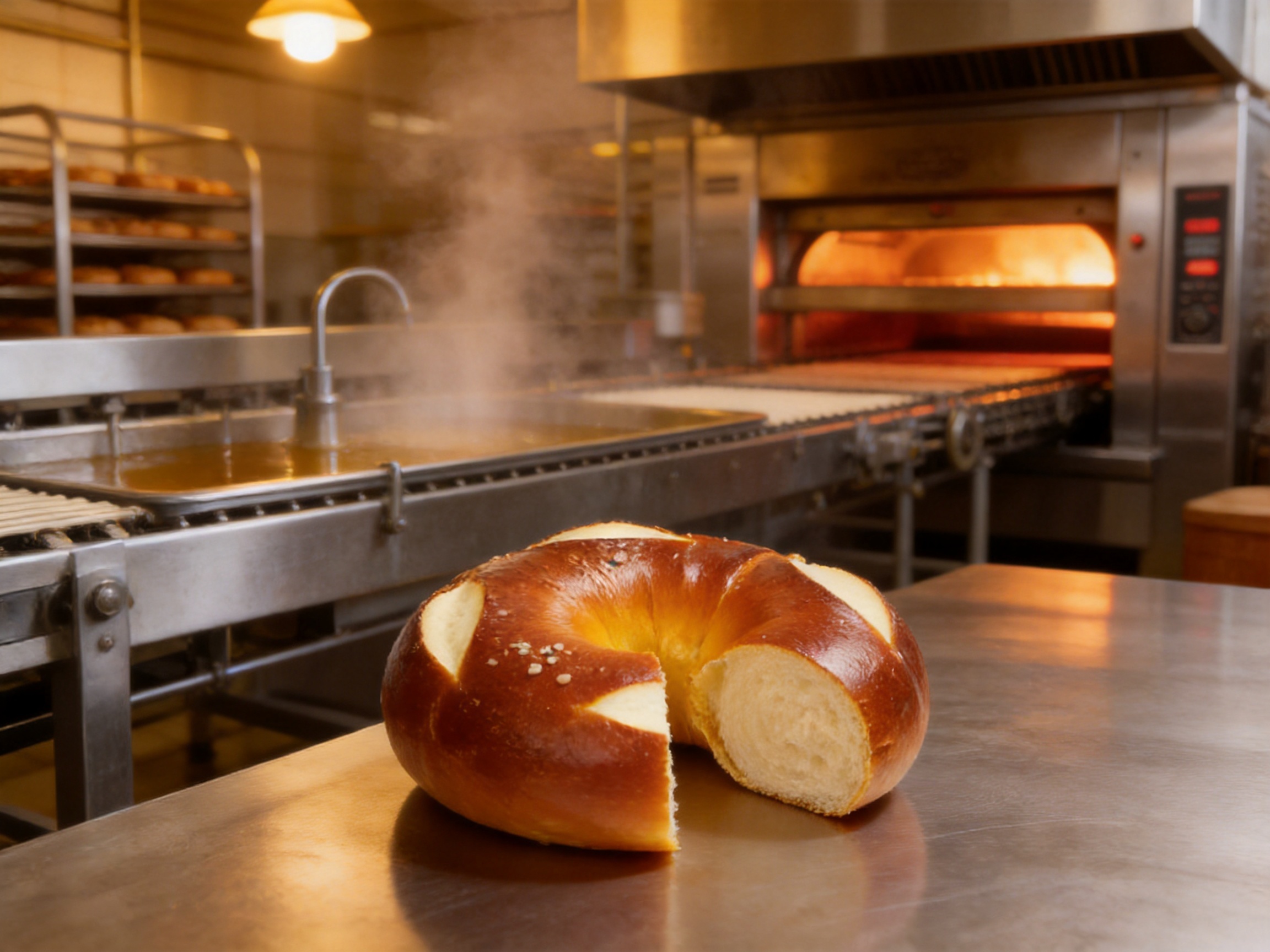
After the alkaline bath, the bagels are baked at high temperature. This stage drives browning reactions that create the deep color and roasted aroma associated with a well-developed crust. The Maillard reaction involves interactions between amino compounds and reducing sugars under heat. In bakery products, it contributes to crust color, toasted aromas, and layers of flavor that cannot be achieved through low-temperature baking alone.
The objective is not simply to make the exterior darker. High-temperature baking must be balanced so that the crust develops a premium brown finish without becoming burnt, overly dry, or excessively hard. The product description emphasizes a lightly crisp yet resilient surface. This balance is important because a crust that is too soft may fail to deliver the intended pretzel impression, while a crust that is too hard can make the bagel difficult to bite and less adaptable to sandwich applications.
The baking process also contributes to the product’s aroma. When the bagel leaves the oven, the combination of toasted wheat notes, browned crust, and savory pretzel character creates an immediate sensory signal. Aroma can be particularly valuable in cafés, bakery displays, and open-kitchen foodservice settings, where customers often make purchasing decisions based on what they see and smell.
High-temperature baking supports a premium presentation, but it must be integrated with the complete frozen bakery process. The product must retain its structure during cooling, freezing, storage, transportation, and final preparation. This is where manufacturing experience becomes important. A visually attractive bagel that does not perform consistently after freezing would have limited commercial value. The process must therefore connect crust development with reliable downstream handling.
A Carefully Balanced Crust and Interior
The eating experience of the High-Temperature Baking Pretzel Bagel is based on controlled textural contrast. The crust is intended to be lightly crisp, resilient, and pleasantly elastic rather than brittle or tough. Beneath it, the interior provides the substantial bite expected from a bagel and carries a wheat-forward aroma that supports both sweet and savory applications.
A resilient crust is valuable in foodservice because the bagel may be sliced, toasted, filled, transported, or held briefly before serving. If the exterior is too fragile, it may lose its visual appeal during handling. If it is too rigid, it may crack during slicing or create an uncomfortable eating experience. The target balance allows the product to maintain a clear pretzel identity while remaining practical for everyday menu preparation.
The interior also needs enough structure to support fillings. Cream cheese, butter, sliced meats, eggs, cheese, vegetables, sauces, and other ingredients can add weight and moisture. A bagel with insufficient internal strength may collapse or become difficult to eat. The High-Temperature Baking Pretzel Bagel is positioned as a versatile foundation that can hold spreads and sandwich ingredients while retaining its own wheat and pretzel character.
Texture is influenced by multiple factors, including dough formulation, mixing, fermentation, shaping, alkaline treatment, baking, cooling, and freezing. For this reason, the finished bite is not the result of one isolated step. It reflects the coordination of the entire production system. Consistent control across these stages helps protect the product’s quality from the factory to the final serving occasion.
Product Advantages Compared with Standard Bagel Options
The first advantage is distinctive appearance. A deep, glossy brown crust provides a stronger visual cue than the pale or lightly browned surface of many standard bagels. This can help cafés and retailers create a more memorable display and can support premium positioning on menus and product labels.
The second advantage is flavor differentiation. A plain bagel is highly adaptable, but its flavor is relatively neutral. The pretzel-style crust introduces savory, toasted, and lightly salty notes that can reduce the need for heavy seasoning or complicated toppings. Operators can build a simple menu item around the bagel itself while still offering a clearly differentiated experience.
The third advantage is cross-category flexibility. The product can serve customers who enjoy bagels, pretzels, sandwiches, bakery snacks, and quick-service breakfast foods. This allows one item to participate in several menu sections. A café may sell it with cream cheese in the morning, use it as an egg sandwich carrier at lunch, and offer it with a savory spread as an afternoon snack.
The fourth advantage is compatibility with both classic and creative applications. It can support traditional toppings while also pairing with smoked meats, roasted vegetables, specialty cheeses, spicy sauces, or plant-based fillings. The crust supplies enough character to remain noticeable, but it does not prevent the product from working with different flavor systems.
The fifth advantage is operational consistency. A commercial frozen bagel can help businesses reduce preparation complexity compared with producing dough, shaping bagels, managing alkaline treatment, and baking from scratch in every location. A professionally manufactured product gives operators a standardized base that can be prepared according to their service model.
Product Advantages Compared with Conventional Soft Pretzels
Soft pretzels have a strong identity, but their shape and serving format may restrict their use. They are often associated with snacks, stadium food, kiosks, or casual concessions. The High-Temperature Baking Pretzel Bagel offers a pretzel-inspired crust in a format that is easier to integrate into breakfast, brunch, café, bakery, and sandwich menus.
The round bagel format creates a natural opening for fillings. This makes the product suitable for breakfast sandwiches, deli builds, open-faced presentations, and packaged grab-and-go meals. It can also be sliced and toasted using equipment already found in many cafés and foodservice operations.
Another advantage is consumer familiarity. Customers who already understand how to eat a bagel do not need to learn a new serving format. At the same time, the pretzel-style crust adds novelty and makes the item feel more distinctive than a plain or sesame bagel.
The product therefore combines the accessibility of a bagel with the flavor appeal of a pretzel. This balance can help operators attract customers looking for something familiar but not ordinary.
Manufacturing Strengths Behind the Product
Jiangsu Goobagel Food Technology Co., Ltd. is a modern frozen bakery producer specializing in bagel research and manufacturing. Its operations cover raw materials, research and development, production, and distribution. This integrated supply-chain structure supports more coordinated decision-making than a fragmented production model.
When raw-material sourcing, formulation development, production planning, quality control, and distribution are connected, manufacturers can respond more efficiently to product requirements. For a specialized item such as a pretzel bagel, this is valuable because the desired crust, aroma, interior texture, and frozen performance must be considered together.
The company has developed more than 100 clean-label bagel varieties. This breadth indicates experience with different flavors, textures, formats, and application needs. Product-development experience can support customization for retail, foodservice, café chains, tea brands, bakery operators, and private-label customers.
Rather than treating each bagel as an isolated product, an experienced manufacturer can apply knowledge from one product-development project to another. Lessons related to dough handling, shaping, surface treatment, freezing, packaging, and rethermalization can strengthen the development of future varieties. This accumulated expertise is particularly useful when customers need a product adapted to a specific market or menu concept.
The company’s focus on stable quality and reliable supply is also important. Foodservice customers need predictable deliveries, consistent specifications, and repeatable product behavior. Retail customers require uniform appearance and portion characteristics across multiple production lots. A manufacturing system designed for commercial distribution must therefore prioritize both product quality and supply continuity.
Integrated Research and Development
Research and development is a central strength in a category where small changes can significantly affect the finished product. A bagel’s final quality depends on the relationship between ingredients, dough development, fermentation, shaping, alkaline treatment, baking, cooling, and freezing. Product developers must consider how each stage influences the next.
For the High-Temperature Baking Pretzel Bagel, development work includes establishing the intended crust color, gloss, aroma, bite, and internal structure. It also includes evaluating how the product performs after freezing and final preparation. A successful commercial formula must work not only when freshly baked in a controlled test environment but also when produced at scale and prepared by customers or foodservice staff.
R&D teams must also consider application requirements. A bagel intended for cream cheese service may have different needs from one used for a loaded sandwich. A retail product may need packaging and storage characteristics that differ from a café product prepared and served on the same day. By developing a broad portfolio, Goobagel can draw on experience across these use cases.
Clean-label development is another relevant capability. Customers increasingly want clear ingredient positioning and products that align with modern expectations for transparency and simplicity. The company describes its bagel portfolio as clean-label, supporting applications where retailers, café chains, and foodservice operators want to communicate a straightforward product proposition.
Commercial Applications
Breakfast Menus
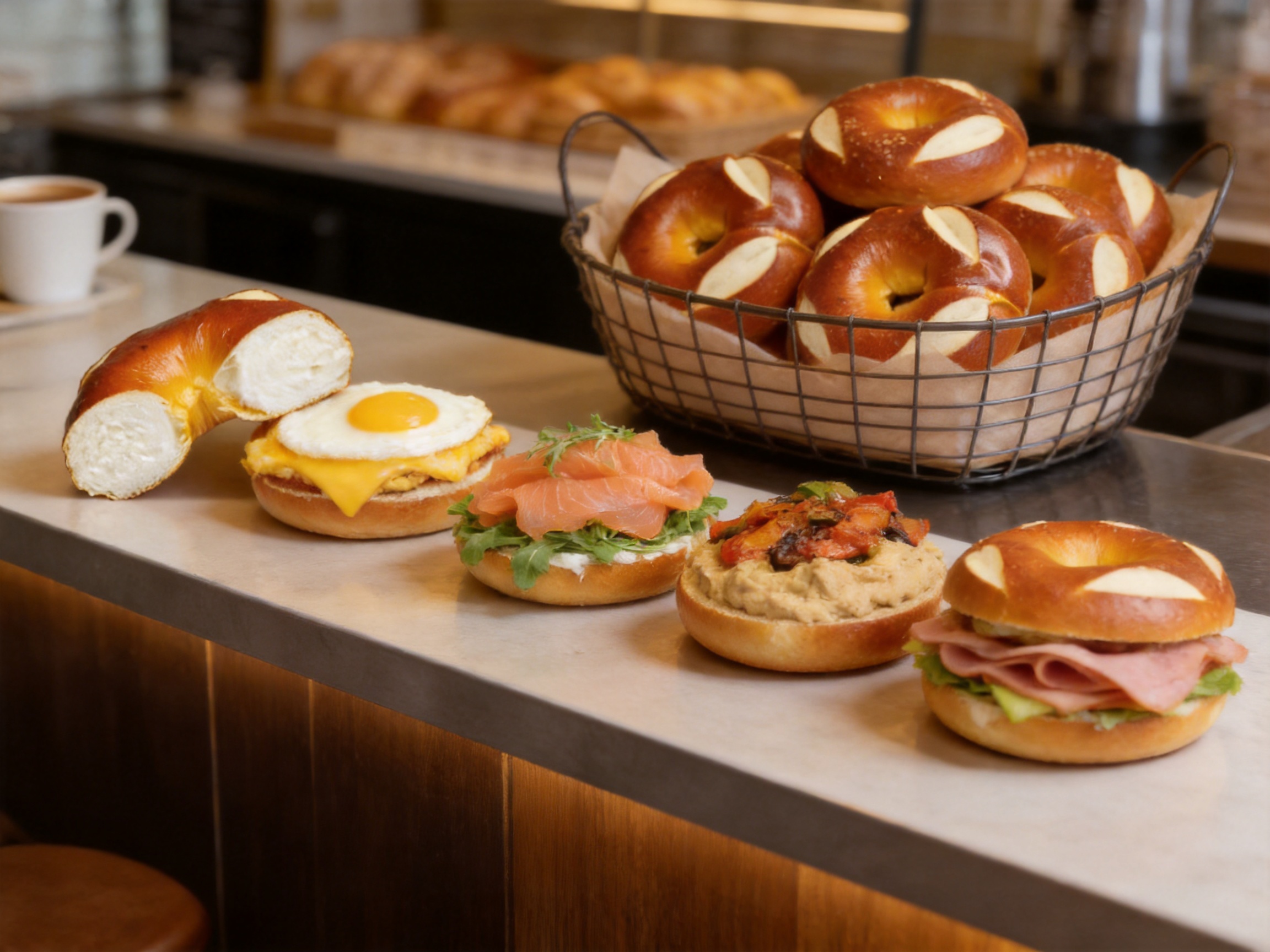
The product is naturally suited to breakfast. Its substantial interior provides a satisfying base for eggs, cheese, breakfast meats, vegetables, or plant-based proteins. The pretzel-style crust adds a savory note that can complement eggs and cheese without requiring a complicated sauce system.
For a simple breakfast offering, the bagel can be toasted and served with butter, cream cheese, or a savory spread. For a premium option, it can carry scrambled eggs, smoked salmon, avocado, roasted vegetables, or specialty cheese. Its visual appearance can make even a simple preparation look more distinctive on a menu board or in a display case.
Café and Coffee-Shop Service
Cafés often need food products that are easy to prepare, recognizable to customers, and suitable for different times of day. The High-Temperature Baking Pretzel Bagel can support a morning pastry program while also functioning as a lunch or afternoon snack item. Its toasted grain aroma and glossy crust make it suitable for display near coffee, tea, and other beverages.
The product can be offered as a whole bagel, sliced and toasted, or assembled into a warm sandwich. Café operators can use a small number of toppings to create several menu variations, helping control inventory while still providing customer choice.
Sandwich and Deli Applications
The bagel’s structure makes it a practical carrier for deli meats, cheese, chicken, tuna, vegetables, and sauces. Its pretzel-style flavor can enhance familiar sandwich combinations and provide a point of difference from ordinary bread rolls.
For high-volume operations, consistency is especially important. Sandwich assembly is easier when the product slices evenly, maintains enough internal strength to hold fillings, and remains appealing after toasting. The resilient crust can contribute to a satisfying first bite and help the sandwich feel substantial.
Retail and Grab-and-Go
In retail, the product can be positioned as a premium frozen bakery item or as part of a prepared grab-and-go range. Its dark glossy appearance provides strong shelf and display recognition. Product descriptions can emphasize the high-temperature baking process, pretzel-style crust, and versatile use occasions.
For grab-and-go operations, the bagel can be paired with fillings and packaged as a ready-to-eat sandwich. Its flavor profile can support both classic and contemporary combinations, allowing retailers to create multiple stock-keeping units from one core bakery product.
Tea Brands and Bakery Operators
Tea brands and bakery operators increasingly use savory bakery items to expand beyond sweet products. A pretzel-style bagel can provide balance within a display that includes cakes, pastries, cookies, and sweet breads. Its savory aroma and darker color can attract customers seeking a less sweet option.
Bakery operators may also use the product as a base for premium topping concepts. Cream cheese variations, herb spreads, cheese melts, smoked ingredients, and vegetable toppings can transform the bagel into a composed bakery item without requiring a separate dough-production process.
Menu Ideas for the Pretzel Bagel
| Menu Concept | Key Ingredients | Primary Selling Point | Suitable Channel |
|---|---|---|---|
| Classic Pretzel Cream Cheese Bagel | Cream cheese, butter, or savory spread | Simple preparation with strong crust identity | Cafés, breakfast counters, retail |
| Egg and Cheese Breakfast Bagel | Egg, melted cheese, optional breakfast protein | Filling, warm, and convenient | Quick service, cafés, convenience retail |
| Smoked Salmon Bagel | Smoked salmon, cream cheese, onion, greens | Premium café or brunch positioning | Restaurants, hotels, specialty cafés |
| Roasted Vegetable Bagel | Roasted vegetables, hummus, greens | Plant-forward and colorful | Cafés, bakery shops, health-focused menus |
| Deli Pretzel Bagel | Sliced meat, cheese, mustard, pickles | Pretzel flavor paired with sandwich familiarity | Delis, foodservice, grab-and-go |
| Open-Faced Specialty Bagel | Whipped cheese, herbs, vegetables, seeds | High visual appeal for display and social media | Bakery cafés, brunch menus, tea brands |
Frozen Bakery Performance
Frozen bakery products provide important operational advantages. They can help businesses maintain a stable inventory, reduce daily dough preparation, and standardize product output across locations. For chains and distributors, frozen formats can simplify logistics and make it easier to supply multiple outlets from a central manufacturing source.
The value of a frozen bagel depends on more than its ability to remain frozen. It must retain a satisfactory crust, interior texture, aroma, and appearance after storage and preparation. The product must also be practical for the equipment and workflow used by the customer.
Goobagel’s experience as a frozen bakery producer supports this commercial requirement. Its integrated production model is designed to connect manufacturing with distribution, helping protect product consistency through the supply chain. For customers purchasing wholesale quantities, predictable performance is essential for menu planning, costing, staff training, and customer satisfaction.
Frozen inventory can also reduce waste when managed correctly. Operators can prepare quantities according to demand rather than producing an entire day’s supply in advance. This flexibility is useful for cafés with changing traffic patterns, retailers with variable sales, and foodservice operators serving multiple meal periods.
Consistency as a Competitive Advantage
Consistency is one of the clearest advantages a specialized manufacturer can provide. Customers expect the same crust color, shape, size, aroma, and bite whenever they purchase a product. Inconsistent bagels can create problems in portion control, packaging, photography, menu descriptions, and customer expectations.
For commercial buyers, consistency also improves training. Staff can learn a repeatable preparation method and apply it across shifts and locations. This reduces dependence on individual baking skill and makes it easier to maintain a standard customer experience.
Uniformity is particularly important for private-label programs. Retailers and foodservice brands invest in packaging, marketing, and menu development around a defined product specification. A manufacturing partner must be able to reproduce that specification over time while supporting reliable supply.
The High-Temperature Baking Pretzel Bagel is positioned as a stable commercial staple rather than a limited novelty. Its strong flavor identity attracts attention, while its standardized format supports routine operations. This combination allows it to function as both a signature item and a dependable base product.
Private Label and OEM Potential
OEM and private-label customers often require more than a finished product. They may need assistance with product selection, formulation adjustments, packaging direction, specification development, and supply planning. A manufacturer with a broad bagel portfolio and integrated capabilities can provide a more complete development pathway.
The pretzel bagel can be adapted conceptually for different customer groups. A café chain may emphasize premium crust and sandwich performance. A retailer may focus on household preparation and freezer convenience. A bakery brand may highlight the high-temperature process and toasted wheat flavor. The core product can support different marketing approaches without losing its fundamental identity.
Private-label development also benefits from a clear technical foundation. The more clearly the process is defined, the easier it is to establish product specifications and quality expectations. The alkaline bath, high-temperature bake, crust appearance, interior texture, and application performance can all form part of a customer’s product brief.
For international buyers, communication and supply reliability are equally important. Jiangsu Goobagel Food Technology Co., Ltd. provides a direct manufacturing relationship for customers seeking frozen bagel products from China. Its experience with domestic brand customers and multiple commercial channels provides a foundation for wider OEM and wholesale cooperation.
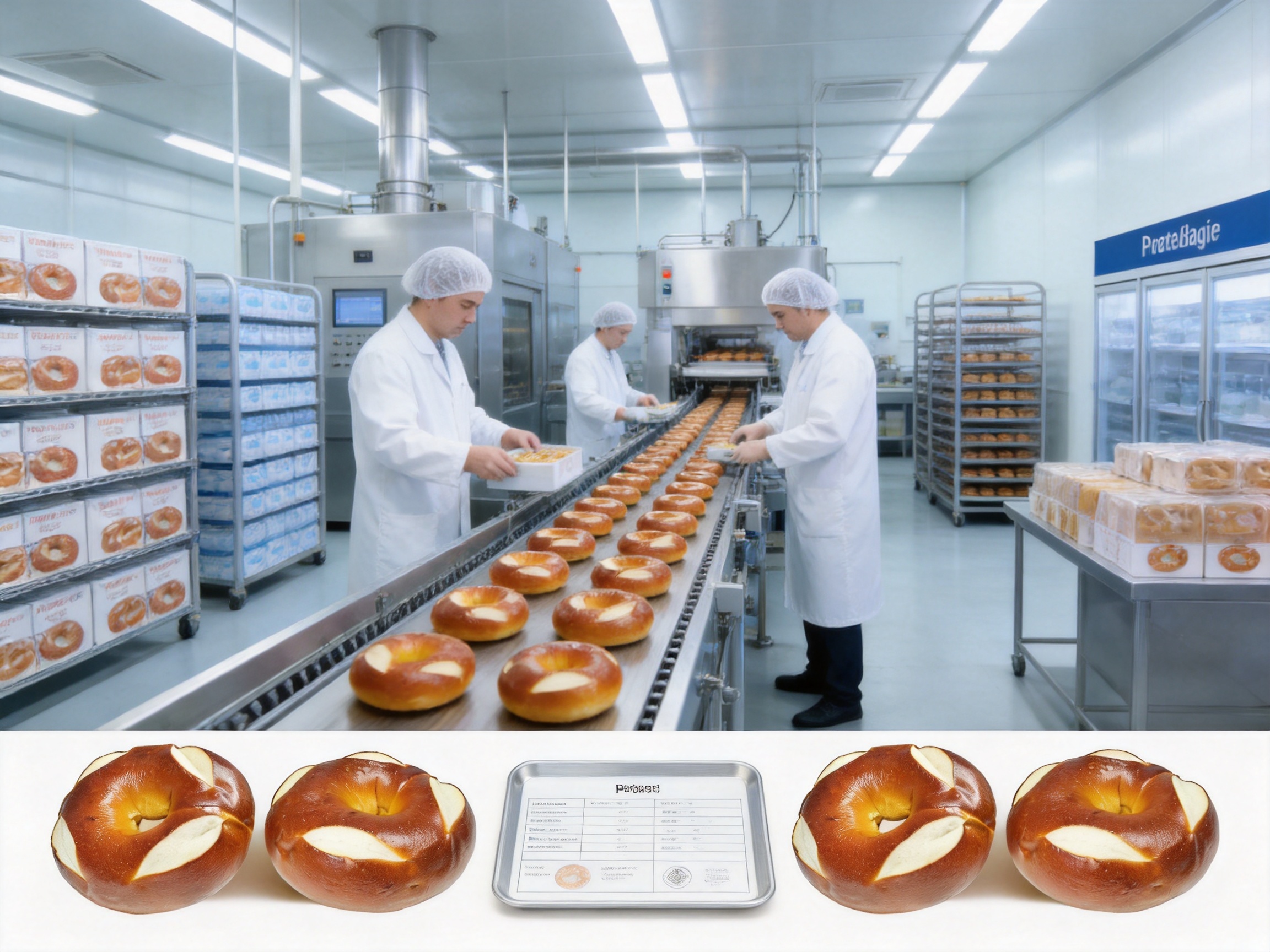
Quality and Process Considerations
A premium pretzel bagel requires control at every stage. Raw materials must be selected for their contribution to dough structure, flavor, color, and frozen stability. Mixing must develop the dough appropriately without creating an uneven or weak structure. Fermentation must be managed to support the desired interior texture.
Shaping must produce a recognizable bagel form with consistent dimensions. The alkaline bath must be applied for the intended duration and under controlled conditions. Baking must provide the desired gloss, color, aroma, and crust texture. Cooling and freezing must then protect those qualities during storage and transportation.
Each stage has a direct effect on the final product. If dough development is insufficient, the interior may lack structure. If the surface treatment is inconsistent, crust color and flavor may vary. If baking is not balanced, the exterior may be too pale, too dry, or overly hard. If freezing is poorly controlled, texture may suffer during final preparation.
An integrated manufacturer can monitor these relationships more effectively because product development and production experience are connected. This helps reduce the gap between laboratory samples and commercial batches. It also supports continuous improvement when customers provide feedback from real menu applications.
Why the Product Stands Out in a Crowded Market
The frozen bakery market includes many familiar products, and ordinary bagels can be difficult to differentiate. A pretzel-style crust gives this product an immediate point of distinction. It is visible, aromatic, and easy to explain. Buyers can understand the product concept quickly: a bagel format with a glossy, savory pretzel crust created through an alkaline bath and high-temperature baking.
Its differentiation does not depend on an unusual filling or a short-lived trend. The product’s identity comes from its process and core eating experience. This gives operators room to create their own applications while retaining a consistent signature base.
The bagel also benefits from broad consumer familiarity. Customers do not need extensive education to understand the format. The pretzel element provides discovery, while the bagel format provides comfort and usability. That combination can help reduce the risk associated with introducing a completely unfamiliar bakery item.
From a business perspective, the product can support menu flexibility, operational efficiency, and brand storytelling. From a consumer perspective, it offers a crust with visual appeal, a savory toasted flavor, and a satisfying bagel texture. These advantages reinforce one another and create a stronger value proposition than appearance alone.
Serving and Preparation Recommendations
The bagel can be served whole for a simple bakery presentation or sliced for spreads and sandwiches. Toasting can intensify the wheat aroma and add additional contrast between the crust and interior. Operators should select preparation settings that warm the center without excessively drying the surface.
For spread-based service, cream cheese, whipped cheese, butter, herb spreads, hummus, mustard, and savory sauces can all complement the pretzel character. Ingredients with acidity, creaminess, or fresh herbal notes can balance the toasted crust.
For sandwich applications, the bagel works well with ingredients that provide contrast in moisture and texture. Eggs, melted cheese, smoked fish, deli meats, roasted vegetables, greens, and pickled components can create balanced combinations. Because the bagel already contributes a noticeable flavor, toppings do not need to be excessively seasoned.
For retail or grab-and-go use, operators should consider how the product will be packaged after preparation. Ventilation, holding time, filling moisture, and serving temperature can influence crust texture. A well-designed preparation and packaging process helps preserve the intended lightly crisp bite.
Brand and Menu Positioning
The product can be positioned as a premium everyday staple. Its appearance and production story create a premium impression, while its flexible format allows frequent use. This is often more valuable than a product that looks premium but can only be sold on special occasions.
Menu language can highlight the glossy pretzel crust, high-temperature baking, toasted wheat aroma, and versatile serving options. The story should remain clear and factual. Customers are likely to respond to specific details such as an alkaline bath, deep-brown crust, lightly crisp bite, and bagel-style interior.
For retail packaging, the product may be presented as a specialty frozen bagel suitable for breakfast, sandwiches, snacks, and entertaining. For foodservice menus, it can be named according to the intended use, such as a pretzel breakfast bagel, pretzel deli sandwich, or toasted pretzel bagel with cream cheese.
For private-label customers, the product can support a brand identity centered on craft, quality, convenience, or innovation. Its process story gives marketers useful content without requiring an overly complex explanation.
Company Capabilities and Partnership Value
Jiangsu Goobagel Food Technology Co., Ltd. has specialized in bagel research and manufacturing since 2019. The company’s mission is to provide customers with high-quality and healthy products while creating opportunities for partners to realize their goals. Its stated values include persistence, craftsmanship, respect, and science.
These values are relevant to a product that depends on detailed process control. Craftsmanship supports attention to crust and texture. Science supports repeatable treatment, baking, freezing, and quality evaluation. Persistence supports continuous product development. Respect supports collaboration with customers, distributors, and brand partners.
The company’s vision of striving for a better life is reflected in the development of convenient bakery products that can fit modern eating occasions. Its portfolio serves retail, foodservice, café chains, tea brands, and bakery operators, giving it experience across several commercial environments.
For buyers, the partnership value lies in the combination of product expertise and manufacturing infrastructure. The High-Temperature Baking Pretzel Bagel is not simply a single finished item; it is part of a broader bagel-development capability that can support future product extensions, customized specifications, and private-label programs.
Frequently Asked Questions
What is a High-Temperature Baking Pretzel Bagel?
It is a bagel with a pretzel-style exterior created through an alkaline bath followed by high-temperature baking. The process produces a deep glossy-brown crust, a toasted wheat aroma, and a lightly crisp, resilient bite while preserving the substantial interior associated with a bagel.
How does the alkaline bath affect the product?
The alkaline bath helps prepare the surface for pretzel-style crust development. In this product, each piece is immersed for more than 30 seconds before baking. The treatment contributes to the finished color, surface structure, sheen, aroma, and savory flavor impression.
How is this product different from a plain bagel?
A plain bagel generally offers a more neutral flavor and a lighter surface appearance. The Pretzel Bagel has a deeper brown crust, stronger toasted notes, and a more noticeable savory character. It can still be used in the same general ways as a plain bagel, but it provides greater visual and flavor differentiation.
How is it different from a soft pretzel?
It combines the pretzel-inspired crust of a soft pretzel with the round, sliceable, filling-friendly format of a bagel. This makes it suitable for breakfast sandwiches, deli sandwiches, café service, spreads, and retail applications in addition to snack occasions.
Can it be used for sandwiches?
Yes. Its substantial interior and resilient crust make it suitable for egg sandwiches, deli builds, cheese melts, smoked fish, roasted vegetables, plant-based fillings, and other sandwich concepts.
What types of businesses can use this product?
Potential users include cafés, bakery shops, restaurants, hotels, tea brands, convenience retailers, supermarkets, foodservice distributors, catering operations, and private-label food brands. Its versatile format supports breakfast, lunch, snack, and grab-and-go programs.
Why is the high-temperature baking process important?
High-temperature baking supports the development of deep crust color, surface gloss, toasted grain aromas, and a more pronounced Maillard flavor profile. The process must be carefully balanced to create a lightly crisp and resilient crust rather than an exterior that is burnt, excessively dry, or too hard.
Is the product suitable for frozen distribution?
Yes. It is developed as a frozen bakery product for commercial supply. Frozen distribution can help customers manage inventory, standardize preparation, reduce daily dough-production requirements, and serve multiple locations from a reliable manufacturing source.
Can the product be used in private-label programs?
Yes. The manufacturer provides OEM and private-label bagel capabilities. Buyers can discuss product specifications, application requirements, packaging needs, and supply arrangements according to their market and brand positioning.
What makes the manufacturer suitable for commercial cooperation?
Jiangsu Goobagel Food Technology Co., Ltd. integrates raw materials, research and development, production, and distribution. It has specialized in bagel research and manufacturing since 2019 and has developed more than 100 clean-label bagel varieties for different commercial channels.
Conclusion
The High-Temperature Baking Pretzel Bagel offers a practical combination of distinctive appearance, savory crust character, bagel-style versatility, and commercial consistency. Its more-than-30-second alkaline bath creates the foundation for a pretzel-inspired surface, while high-temperature baking develops a deep glossy crust, toasted aroma, and appealing bite.
Compared with standard bagels, it provides stronger visual and flavor differentiation. Compared with conventional soft pretzels, it offers a more flexible format for breakfast, sandwiches, cafés, retail, and bakery applications. Its lightly crisp exterior and wheat-forward interior allow it to work with simple spreads, premium toppings, deli ingredients, and creative menu concepts.
The product is supported by the integrated manufacturing capabilities of Jiangsu Goobagel Food Technology Co., Ltd., a frozen bakery producer with expertise in bagel research, product development, production, and distribution. The company’s broad portfolio, clean-label development focus, and experience serving commercial customers provide a strong foundation for wholesale, OEM, and private-label cooperation.
For businesses seeking a signature bakery item that remains operationally flexible, the High-Temperature Baking Pretzel Bagel can serve as both a distinctive menu feature and a dependable everyday staple. It brings together process-driven quality, recognizable consumer appeal, and broad application potential in one versatile frozen bakery product.
References
1. Goobagel Food product information for the High-Temperature Baking Pretzel Bagel, including product description, processing characteristics, and application positioning.
2. Goobagel Food company information concerning bagel research, frozen bakery manufacturing, clean-label product development, and commercial supply capabilities.
3. General food science references on alkaline treatment in pretzel production and its influence on crust color, surface structure, aroma, and flavor.
4. General baking science references on the Maillard reaction and the development of toasted aromas and browned crusts during high-temperature baking.
5. General frozen bakery references concerning product consistency, frozen storage, distribution, preparation, and foodservice applications.
