
 中文简体
中文简体
 English





postmaster@goobagelfood.com
Content
- 1 A Modern Interpretation of the Filled Bagel
- 2 Product Profile and Core Specifications
- 3 Why the Flavor Combination Works
- 4 Advantages Over Conventional Bagel Products
- 5 Designed for Frozen Bakery Performance
- 6 Integrated Manufacturing Strengths
- 7 Clean-Label Product Development and Commercial Flexibility
- 8 Applications Across Multiple Sales Channels
- 9 Operational Benefits for Buyers
- 10 Branding and Private-Label Opportunities
- 11 Quality Considerations in Commercial Bagel Manufacturing
- 12 How the Product Supports Consumer Expectations
- 13 Preparation and Serving Concepts
- 14 Why a Specialized Bagel Manufacturer Matters
- 15 Positioning Against Competing Products
- 16 Suitable Buyers and Partnership Models
- 17 Frequently Asked Questions
- 17.1 What is the Golden and Crispy Potato Bacon Bagel?
- 17.2 What makes this product different from a plain bagel?
- 17.3 What textures can customers expect?
- 17.4 Is the product suitable for cafés?
- 17.5 Can the product be used in retail?
- 17.6 Why is the 78g size commercially useful?
- 17.7 What role does the mozzarella play?
- 17.8 Does the potato filling make the product mild?
- 17.9 What company manufactures the product?
- 17.10 What are the manufacturer’s main strengths?
- 17.11 Is OEM or private-label cooperation available?
- 17.12 What information should buyers request before placing an order?
- 18 Conclusion
- 19 References
- 20 Product: Golden And Crispy Potato Bacon Bagel
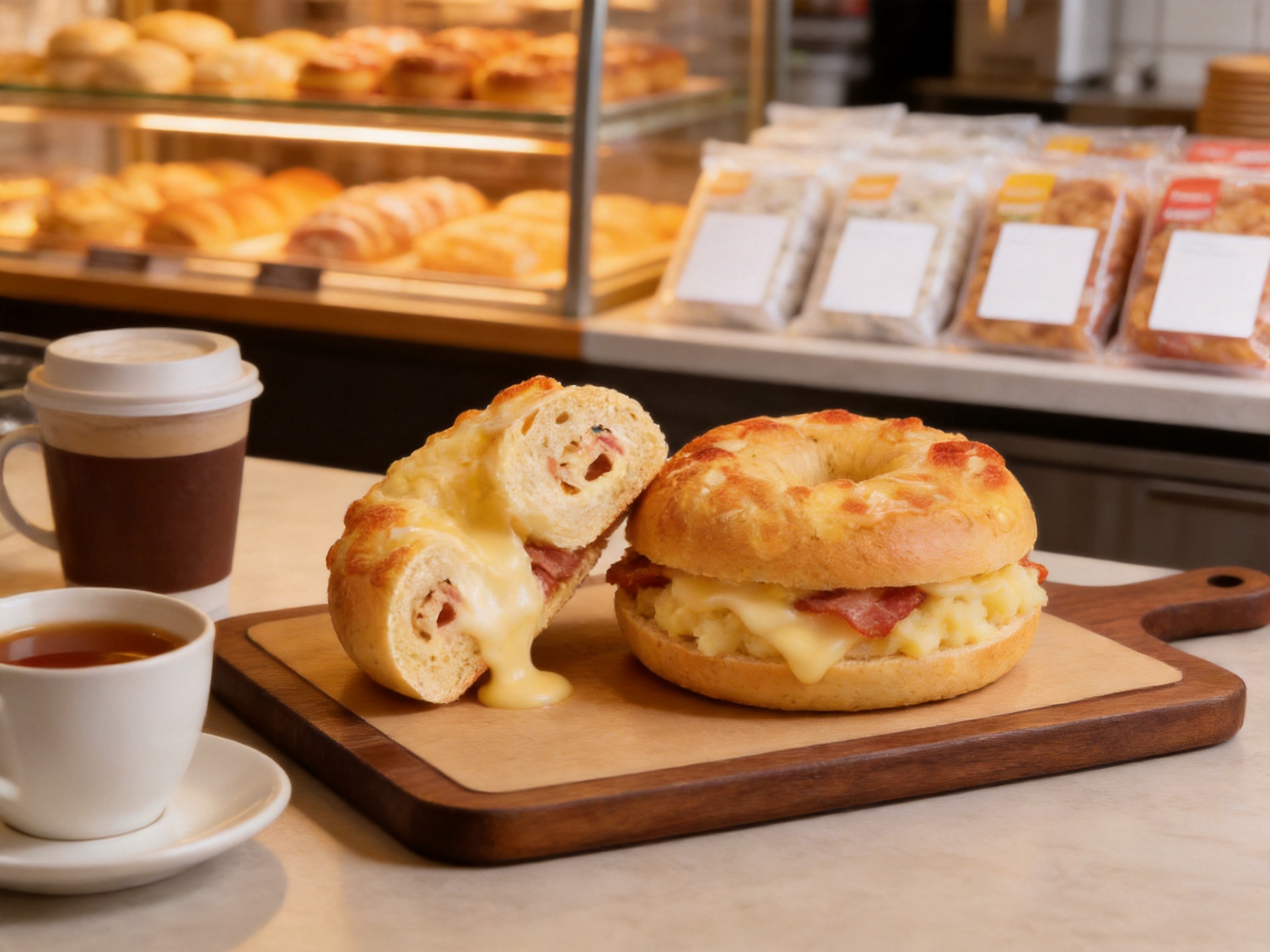
The Golden and Crispy Potato Bacon Bagel brings together three familiar comfort-food ingredients in one convenient, commercially versatile product: fluffy potato mash, savory bacon, and melted mozzarella. Designed for customers who want a satisfying baked snack or light meal, this 78g filled bagel combines a crisp golden exterior with a soft, savory center. Its layered flavor profile gives it a broader appeal than a plain bagel, while its frozen bakery format supports consistent preparation across cafés, retail counters, foodservice operations, and chain stores.
For buyers, distributors, and foodservice operators, the product is more than an attractive combination of ingredients. It represents a practical solution for businesses seeking differentiated bagel products with repeatable quality, efficient preparation, and dependable supply. The combination of a familiar bagel base and an indulgent filling makes it suitable for breakfast menus, afternoon snacks, bakery displays, convenience channels, and ready-to-heat food programs.
A Modern Interpretation of the Filled Bagel
Traditional bagels are valued for their chewy texture, toasted grain aroma, and ability to pair with sweet or savory toppings. Filled bagels build on these qualities by placing the main flavor experience inside the product. Instead of requiring a separate spread, meat filling, or topping, a filled bagel creates a complete bite in a compact format.
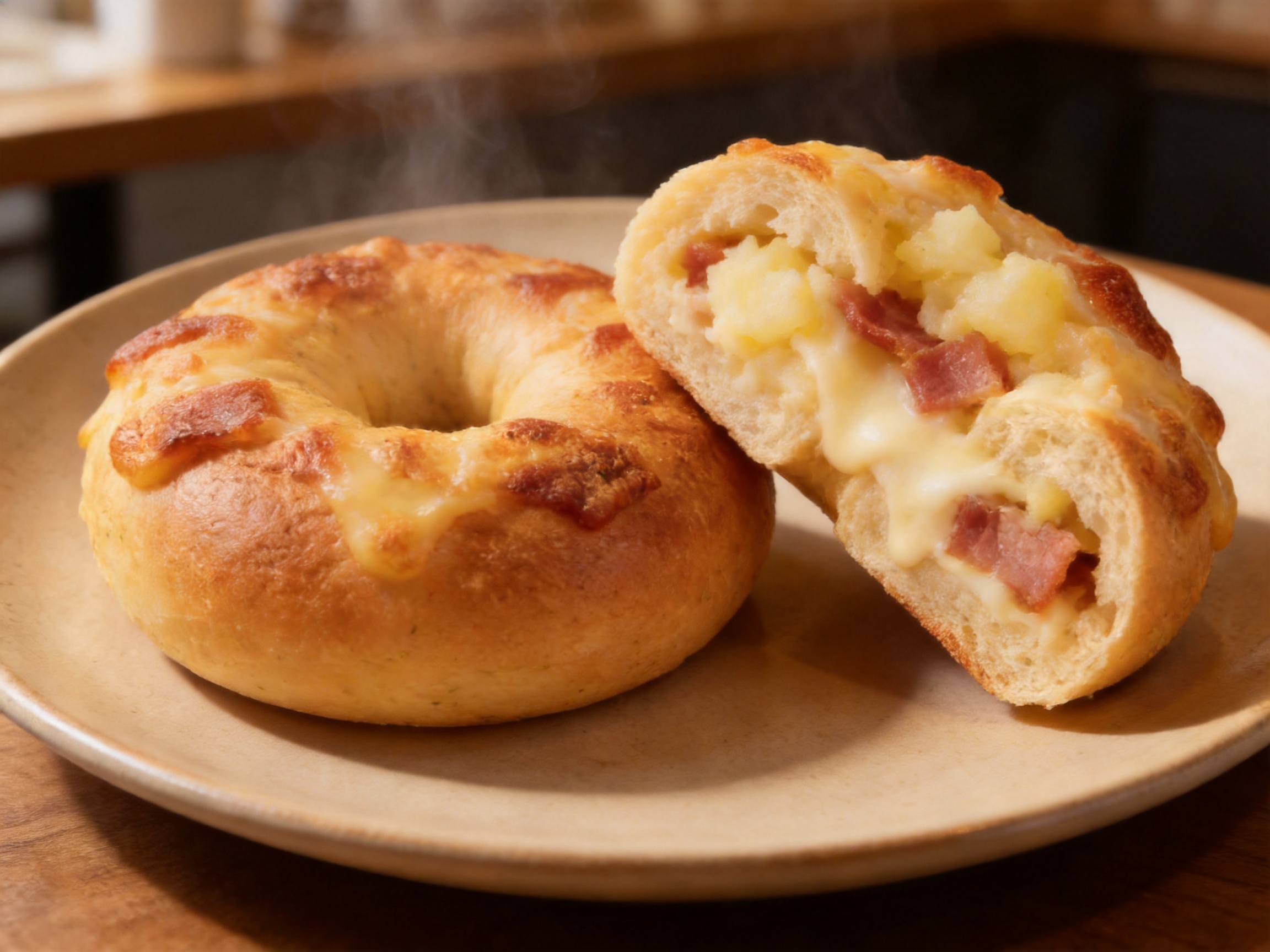
The Golden and Crispy Potato Bacon Bagel develops this idea through a carefully balanced combination of textures. The outside is baked until golden and crisp, creating a toasted first impression. The mozzarella contributes a lightly browned, aromatic finish and a stretchy texture when heated. Inside, potato mash supplies a soft and creamy body, while bacon adds saltiness, smokiness, and a more pronounced savory finish.
This layered structure helps the product stand apart from plain bagels, cheese-only bagels, and simple meat-filled bakery items. Each component contributes a different sensory function. The bagel delivers chew and grain flavor. The mozzarella provides richness and visual appeal. The potato creates a smooth and comforting filling. The bacon adds character and a lingering savory note.
Rather than relying on one strong ingredient, the product builds satisfaction through progression. The first impression comes from the toasted crust and browned cheese. The middle of the bite becomes softer through the potato filling. The finish is strengthened by bacon’s smoky and savory notes. This sequence gives the product a more complete eating experience without requiring complicated serving preparation.
Product Profile and Core Specifications
| Product Attribute | Product Information | Commercial Relevance |
|---|---|---|
| Product name | Golden and Crispy Potato Bacon Bagel | Clear positioning around texture and filling ingredients |
| Product weight | 78g | Convenient individual serving size for snacks, breakfast, and light meals |
| Product type | Filled savory bagel | Suitable for bakery, café, retail, and foodservice menus |
| Primary filling | Fluffy potato mash and savory bacon | Combines comfort, satiety, saltiness, and smoky flavor |
| Cheese component | Mozzarella topping or layer | Supports browning, aroma, creaminess, and cheese stretch |
| Exterior profile | Golden-baked and crisp | Creates an appetizing visual and textural contrast |
| Supply format | Frozen bakery product | Supports inventory planning and preparation consistency |
| Potential applications | Breakfast, snack, light meal, café display, retail, and foodservice | Allows use across multiple sales channels |
The 78g format offers a useful balance between portion control and satisfaction. It is substantial enough to function as a light meal or breakfast item, while remaining compact enough for impulse purchases and snack occasions. Operators can serve it as a standalone item, pair it with coffee or tea, or include it in a breakfast combination with fruit, yogurt, or other bakery products.
For retailers, an individually portioned product can simplify merchandising and pricing. For cafés and foodservice operators, a consistent unit weight helps support menu costing, purchasing forecasts, and standardized serving procedures. For private-label buyers, the format can serve as a foundation for a branded filled-bagel line.
Why the Flavor Combination Works
Golden-Baked Bagel Exterior
The exterior establishes the product’s identity before the filling is tasted. A golden-baked surface communicates warmth, freshness, and careful preparation. Crispness also adds an important contrast to the soft filling. Without an exterior textural contrast, a filled bakery product can feel uniform. The crisp surface gives the bite definition and makes the product more satisfying.
The bagel base contributes more than structure. Its toasted grain character provides a neutral but flavorful platform for the stronger ingredients inside. The chew associated with a bagel also helps the product feel more substantial than a soft bun or thin pastry. This makes the item suitable for customers looking for a filling snack rather than a purely indulgent treat.
Imported Mozzarella for Aroma and Stretch
Mozzarella contributes visual and sensory appeal. When heated, the cheese melts across the surface and develops a lightly browned edge. This browning adds aroma and makes the product appear freshly finished. The stretch of melted mozzarella also creates an engaging serving moment, especially when the bagel is cut open or pulled apart.
Cheese-only bakery products can sometimes lack depth, particularly when the cheese becomes the sole source of flavor. Here, mozzarella functions as part of a broader composition. Its dairy richness softens the stronger bacon notes and gives the potato filling a more rounded character. The result is creamy without becoming overwhelmingly heavy.
Fluffy Potato Mash
Potato mash forms the soft center of the product. Its mild flavor makes it a natural bridge between the bagel and bacon. Potato also contributes a gentle sweetness, which helps balance the saltiness of the meat and cheese. The smooth texture creates a comforting contrast with the chewy bagel and crisp outer surface.
From a consumer perspective, potato is widely familiar and easy to understand. It does not require an explanation on the menu, and it appeals to customers who prefer hearty, recognizable ingredients. The filling can therefore attract a broad audience, from breakfast customers to students, office workers, and families seeking a convenient savory bakery option.
Savory Bacon Finish
Bacon provides the strongest flavor accent in the filling. Its salty, smoky character gives the product an immediate savory identity and creates a lingering finish. Bacon is also a highly recognizable ingredient that can improve menu appeal and support premium positioning when presented alongside cheese and a crafted bagel base.
The bacon is not intended to overpower the potato or mozzarella. Its role is to sharpen the overall flavor. Potato supplies softness, mozzarella supplies creaminess, and bacon supplies intensity. This balance creates a product that feels indulgent while remaining approachable and suitable for regular consumption.
Advantages Over Conventional Bagel Products
More Complete Than a Plain Bagel
A plain bagel offers flexibility, but it requires additional ingredients, labor, and serving decisions. Operators may need to stock spreads, sliced meats, vegetables, or sauces to turn it into a complete menu item. The Golden and Crispy Potato Bacon Bagel includes its primary flavor components in one unit, reducing the need for additional assembly.
This ready-filled format can improve service speed and simplify staff training. A team member does not need to measure fillings or assemble several components for every order. The product can be heated, presented, and sold with minimal handling. This is particularly useful during breakfast rushes, in compact cafés, and in retail environments with limited preparation space.
More Differentiated Than a Single-Flavor Cheese Bagel
Cheese bagels can be attractive, but they may offer limited flavor progression when cheese is the only prominent ingredient. The combination of potato and bacon gives this product a more distinctive position. It communicates comfort, indulgence, and satiety while retaining the familiar format of a bagel.
The three-part filling also gives businesses more flexibility in marketing. The product can be promoted around crispness, cheese stretch, potato comfort, or bacon flavor, depending on the target channel. A café may emphasize it as a warm breakfast bagel, while a retailer may position it as a convenient savory snack.
More Convenient Than Fresh Assembly
Freshly assembled sandwiches can provide customization, but they also require multiple ingredients, refrigeration space, labor, and daily preparation. A frozen filled bagel can help reduce preparation complexity and support more predictable inventory management. Operators can heat products according to demand rather than preparing a large quantity in advance.
This approach can help limit waste caused by unsold assembled sandwiches. It also allows locations with different sales volumes to maintain a consistent product offering. A small café, a large chain, and a convenience outlet can all use the same core product while adjusting preparation volume to local demand.
Stronger Texture Contrast
Many filled bakery products are soft throughout. This product is designed around contrast: crisp and golden outside, chewy through the bagel, creamy in the center, and savory at the finish. Texture contrast often improves perceived quality because every bite offers variation rather than a single repetitive mouthfeel.
The combination also supports visual merchandising. A golden exterior with melted mozzarella can attract attention in a heated display or promotional photograph. When cut open, the potato and bacon filling provides a clear cross-section that helps customers understand the product immediately.

Golden And Crispy Potato Bacon Bagel
Designed for Frozen Bakery Performance
For commercial buyers, sensory appeal must be matched by operational reliability. Frozen bakery products are valued because they can help extend availability, support centralized production, and simplify preparation at the point of sale. The product’s frozen format is suitable for businesses that need to manage inventory across different locations or serve a consistent item without producing dough and filling on-site.
A successful frozen bagel must preserve the intended relationship between crust, filling, and cheese after storage and reheating. The product should remain recognizable as a bagel, retain a pleasant exterior texture, and deliver a filling that feels integrated rather than separated. These requirements make process control essential.
Goobagel Food has specialized in bagel research and manufacturing since 2019. As a modern frozen bakery producer, the company operates an integrated supply chain covering raw materials, research and development, production, and nationwide distribution. This structure provides a foundation for developing products that are not only creative but also suitable for repeatable commercial supply.
Integrated Manufacturing Strengths
Raw Material Coordination
A filled bagel depends on the coordinated performance of several ingredient groups. The dough must provide the correct structure. The potato filling must maintain a smooth and stable consistency. The bacon must deliver recognizable savory flavor. The mozzarella must melt and brown attractively. Managing these elements requires careful raw material selection and consistent supplier coordination.
An integrated supply chain allows the manufacturer to evaluate ingredients as part of a complete product system. Instead of treating dough, filling, and topping as unrelated components, the production team can consider how they behave together during forming, freezing, storage, and reheating. This systems-based approach is especially important for products with multiple textures.
Reliable raw material coordination also supports product consistency. When ingredient specifications are stable, manufacturers can better control taste, appearance, filling distribution, and finished weight. For wholesale and private-label buyers, this consistency is essential because customers expect the same product experience at every purchase.
Research and Development Capability
Goobagel Food has developed more than 100 bagel varieties, including clean-label product concepts for retail, foodservice, café chains, tea brands, and bakery operators. This breadth indicates experience in adapting bagel products to different flavor preferences, channel requirements, and commercial formats.
Product development in the bagel category involves more than creating a recipe. The manufacturer must consider portion size, filling ratio, production efficiency, freezing behavior, reheating performance, packaging requirements, and target customer expectations. A product that tastes good in a small test batch must also be capable of stable production at commercial scale.
The Golden and Crispy Potato Bacon Bagel reflects this type of development thinking. Its flavor profile is familiar enough for broad acceptance, but its combination of potato, bacon, mozzarella, and a golden bagel exterior gives it a clear point of difference. The result is a product with both consumer accessibility and menu character.
Production and Process Control
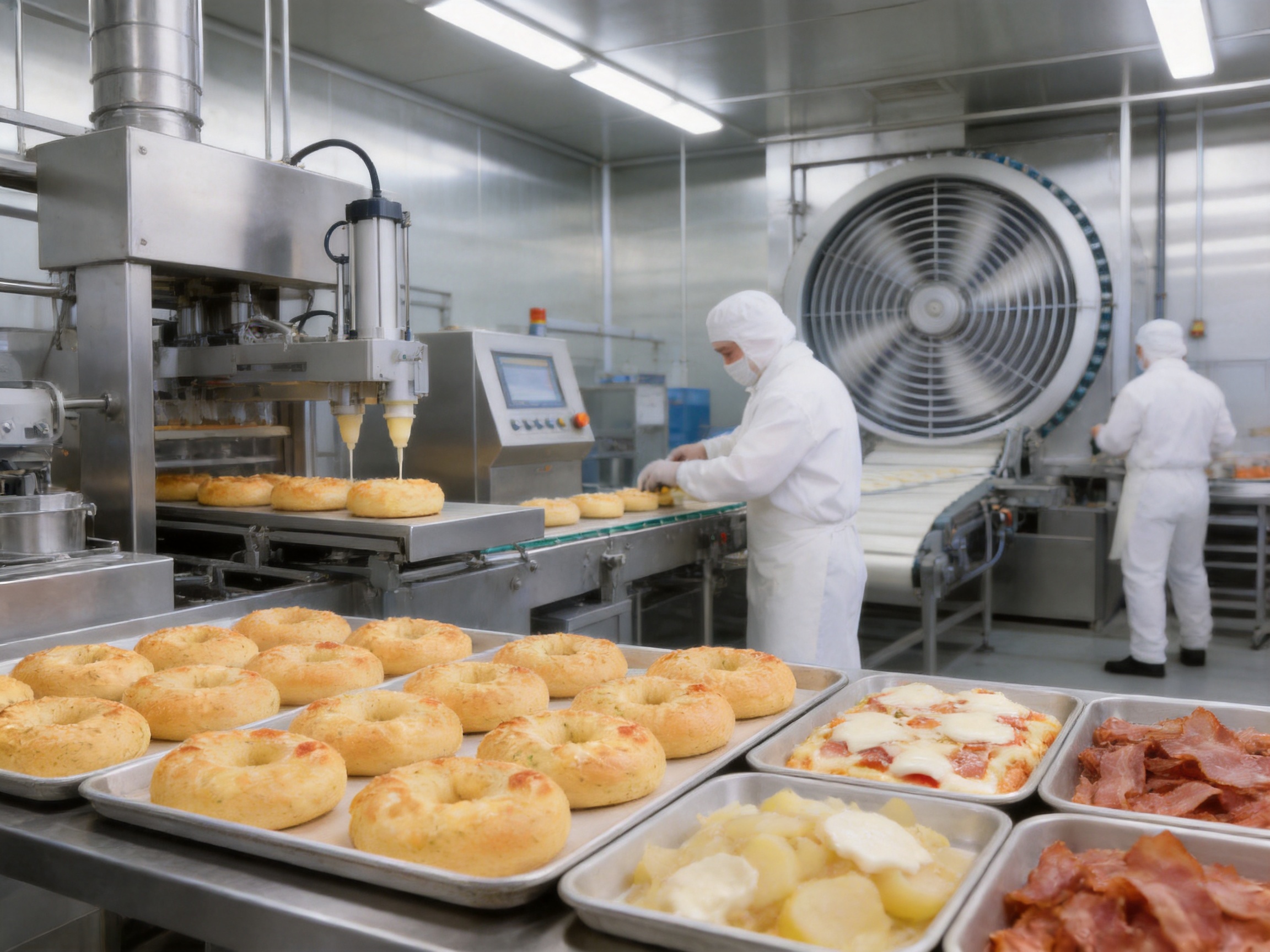
Advanced manufacturing is reflected in the ability to control multiple stages of production. Bagel manufacturing may involve dough preparation, mixing, resting, shaping, filling, sealing, topping, baking, cooling, freezing, packing, and distribution. Each stage can affect the final result.
For a filled product, forming and sealing are particularly important. The filling must be distributed consistently, while the dough must close securely around it. If the filling is uneven, one bite may be too dense while another lacks flavor. If sealing is inconsistent, the product may lose its intended shape or allow filling to escape during baking or reheating.
Temperature management is also important. Dough behavior, cheese performance, potato texture, and final crust development are all affected by temperature. A controlled process helps ensure that the finished item maintains a stable appearance and eating quality across production batches.
Freezing is another critical stage. Rapid and well-managed freezing can help preserve the product’s structure and reduce changes in texture during storage. A manufacturer experienced in frozen bakery production can design products around the realities of frozen distribution rather than treating freezing as an afterthought.
Nationwide Distribution Capability
Goobagel Food’s integrated supply chain includes nationwide distribution in China. Distribution capability matters because a product’s commercial value depends on reliable access, not simply on recipe quality. Retailers, café chains, and foodservice operators require dependable replenishment to maintain menus and avoid stock interruptions.
A coordinated manufacturing and distribution system can also support larger rollouts. When a product performs well in one location, buyers may want to introduce it to multiple stores. Consistent production and organized logistics help make that expansion more practical.
Clean-Label Product Development and Commercial Flexibility
The company has created more than 100 clean-label bagel varieties. Clean-label expectations differ by market and customer segment, but the broader trend is clear: buyers increasingly want ingredient communication to be understandable, product concepts to feel authentic, and formulations to align with modern eating preferences.
The Golden and Crispy Potato Bacon Bagel uses recognizable ingredients with clear culinary roles. Potato, bacon, mozzarella, and bagel dough are easy for customers to understand. This clarity can support menu descriptions, retail packaging, and promotional materials without requiring complicated explanations.
For private-label customers, the product can also provide a base for market-specific development. Buyers may explore packaging style, serving suggestions, flavor naming, portion formats, or channel-specific positioning while using an established product concept. Depending on project requirements, the manufacturer’s research and development capabilities may support adjustments to product characteristics and commercial presentation.
OEM and private-label supply is especially relevant for companies that want to enter the frozen bagel category without building their own bakery infrastructure. A specialized manufacturer can provide technical knowledge, production capability, and product development support, allowing the brand owner to focus on sales, marketing, distribution, and customer relationships.
Applications Across Multiple Sales Channels
Cafés and Coffee Shops
The product pairs naturally with coffee, tea, and other hot beverages. Its savory profile gives customers an alternative to sweet pastries and plain bread products. It can be offered during breakfast, as a mid-morning snack, or as an afternoon item for customers seeking something warm and filling.
Cafés can serve the bagel as a standalone product or include it in a beverage combination. The golden exterior and melted cheese can also support counter-display appeal. Because the product is pre-filled, staff can focus on heating and presentation rather than assembling ingredients during busy periods.
Breakfast Menus
The potato and bacon combination is particularly suitable for breakfast positioning. Potato contributes a familiar morning-food association, while bacon adds a traditional savory breakfast note. The bagel format makes the product portable and easy to consume on the way to work, school, or other activities.
Breakfast operators can use the product as a fixed menu item or rotate it with other filled bagel varieties. Its 78g size may also make it suitable for a lighter breakfast set, especially when combined with a beverage or fruit-based side.
Convenience Stores
Convenience stores often need products that can be stored efficiently, prepared quickly, and consumed without extensive table service. A frozen filled bagel can fit into heated food programs or made-to-order warming systems. The familiar format reduces the need for customer education, while the bacon, potato, and cheese combination provides strong impulse appeal.
For convenience operators, portion consistency and straightforward preparation are valuable. A standardized product can simplify staff instructions and support predictable pricing. It can also be marketed as a warm savory alternative to packaged snacks.
Retail and Supermarket Bakery Sections
Retailers can position the product in frozen bakery, ready-to-heat, or prepared food categories. The product’s filling makes it more complete than an unfilled bagel, while its frozen format can support extended inventory planning compared with short-life fresh bakery products.
Packaging can communicate the key sensory benefits: golden and crispy exterior, mozzarella, fluffy potato, and bacon. Serving imagery can show the melted cheese and cross-section, helping shoppers understand how the product differs from a standard bagel.
Tea Brands and Light-Meal Concepts
Tea brands and beverage-led businesses increasingly benefit from savory food pairings. A filled bagel can provide a substantial accompaniment to milk tea, fruit tea, coffee, or other beverages. The product’s compact size and recognizable ingredients make it suitable for combination deals and afternoon snack promotions.
Its flavor is bold enough to stand beside a beverage, but the potato and mozzarella help keep the profile rounded. This makes it more versatile than products that are extremely spicy, sweet, or strongly seasoned.
Foodservice and Institutional Catering
Foodservice operators can use filled bagels in corporate cafés, school-related food programs, hotel breakfast service, and other organized meal settings, subject to their individual nutritional, allergen, and operational requirements. The consistent format can support portion planning and standardized preparation.
For larger foodservice systems, supply reliability and product uniformity are essential. A manufacturer with experience serving commercial partners can help buyers plan product introductions, replenishment, and menu integration more effectively.
Operational Benefits for Buyers
Product quality is only one part of a successful wholesale program. Buyers also consider ease of storage, preparation requirements, staff workload, menu versatility, and the ability to maintain consistent customer expectations. The Golden and Crispy Potato Bacon Bagel addresses these needs through its filled, portioned, frozen format.
Reduced Assembly Requirements
Because the main filling is already incorporated, operators do not need to prepare a separate bacon-and-potato mixture or assemble cheese layers for every order. This can reduce labor and improve speed during high-demand periods. It also decreases the risk of inconsistent portioning caused by manual assembly.
More Predictable Portion Control
The 78g specification provides a clear basis for menu costing and inventory planning. Buyers can estimate servings per case, forecast usage, and design combination meals around a known individual unit. Consistent weight also helps maintain a uniform customer experience across different locations.
Flexible Preparation and Merchandising
The bagel can be heated and served as needed, making it suitable for made-to-order programs and heated displays. It can also be presented in several ways: whole, sliced, paired with a drink, or included in a breakfast set. This flexibility allows operators to adapt the same product to different sales occasions.
Reduced Product Complexity
Using one integrated item in place of several separate ingredients can simplify purchasing and storage. Operators may be able to reduce the number of components required for a savory breakfast or snack offering. Simplified inventory can be particularly beneficial for smaller locations with limited cold-storage capacity.
Branding and Private-Label Opportunities
The product’s clear flavor identity makes it suitable for branded and private-label programs. A buyer can build a product story around crisp baking, cheese stretch, creamy potato, and savory bacon. These benefits are easy to communicate in packaging copy, menu language, social media content, and in-store signage.
Private-label customers may also use the product as part of a broader bagel portfolio. A range could include classic bagels, stuffed bagels, bagel sandwiches, and other filled savory or sweet varieties. The Golden and Crispy Potato Bacon Bagel would provide a rich savory option within that assortment.
A diversified portfolio can help retailers and foodservice operators serve different preferences. Some customers may want a plain bagel, while others may prefer a more complete filled product. Offering both formats can increase choice without requiring an entirely different bakery category.
For OEM buyers, collaboration with an experienced manufacturer can help translate a market concept into a scalable product. Development discussions may cover target weight, filling balance, surface appearance, package format, reheating instructions, flavor intensity, and intended sales channel. These details are important because a product designed for a café may require different performance characteristics from one intended for retail home preparation.
Quality Considerations in Commercial Bagel Manufacturing
Consistency of Dough Structure
The dough must be strong enough to hold the filling while retaining the characteristic bagel bite. It should not become excessively dense, dry, or fragile after freezing and reheating. Consistent dough development supports both product integrity and customer satisfaction.
Filling Distribution
A filled bagel should provide a balanced amount of potato and bacon throughout the center. Even distribution ensures that customers encounter the intended flavor combination in most bites. It also helps maintain predictable product costing and reduces the chance of uneven finished units.
Cheese Appearance and Melt
The mozzarella component should contribute to the product’s golden appearance and aromatic appeal. A controlled manufacturing process helps support a consistent cheese layer and attractive browning. The cheese should complement the bagel rather than obscure its shape or make handling difficult.
Freezing and Storage Stability
Frozen bakery products must be developed with storage and distribution in mind. Stable freezing and appropriate packaging help protect the product during its commercial journey. Buyers should confirm storage conditions, shelf-life information, preparation methods, and packaging specifications during project discussions.
Food Safety and Allergen Communication
Products containing wheat, milk, and bacon require appropriate allergen and ingredient documentation for the intended market. Buyers should work with the manufacturer to review the applicable specifications, labeling requirements, storage conditions, and preparation guidance before commercial launch. These controls are essential for responsible foodservice and retail operations.
How the Product Supports Consumer Expectations
Consumers increasingly look for food that is convenient but not boring. They want quick preparation without sacrificing flavor, texture, or a sense of indulgence. The Golden and Crispy Potato Bacon Bagel meets this expectation by combining the practicality of a frozen bakery item with the sensory appeal of a freshly heated filled bagel.
The product also responds to the demand for familiar ingredients in convenient formats. Potato, bacon, mozzarella, and bagels are recognizable foods with broad appeal. Their combination feels innovative enough to be interesting while remaining accessible to customers who may be hesitant to try unfamiliar flavors.
Texture is another important part of the consumer experience. Crispness signals freshness and careful preparation. Cheese stretch creates a visual cue associated with warmth and indulgence. Creamy potato supplies comfort, and bacon delivers a savory aroma that can encourage purchase. Together, these features support both first-time trial and repeat consumption.
The product’s versatility can also help businesses serve different dayparts. Breakfast customers may appreciate its bacon and potato profile. Afternoon customers may choose it as a substantial snack. Evening customers may treat it as a light meal or convenient savory option. A single product with several consumption occasions can improve menu efficiency.
Preparation and Serving Concepts
Preparation should follow the manufacturer’s recommended instructions and the operating standards of the specific business. The goal is to restore the intended contrast between a golden exterior, a warm filling, and melted mozzarella.
For café service, the bagel can be heated and served whole, allowing customers to experience the crisp surface first. Cutting it in half can reveal the potato and bacon filling and make the portion easier to share or photograph. A simple garnish or side salad may turn it into a light meal presentation.
For breakfast combinations, the product can be paired with coffee, tea, fruit, yogurt, or a small beverage. For retail settings, packaging can emphasize convenient heating and serving. For foodservice, operators may create a set meal with a drink and a side item, using the bagel as the central savory component.
Because the product already contains cheese and bacon, additional sauces are not necessary. However, optional accompaniments such as tomato relish, herb dressing, mustard, or a mild chili sauce may be offered according to local preferences. Any additions should enhance rather than conceal the balanced potato, bacon, and mozzarella profile.
Why a Specialized Bagel Manufacturer Matters
Working with a specialist can provide advantages over sourcing a filled bagel from a general bakery supplier. Bagels have specific structural and textural requirements, and filled versions introduce additional technical challenges. A manufacturer focused on bagel research and production is more likely to understand the relationship between dough development, shaping, filling, baking, freezing, and reheating.
Goobagel Food’s specialization in bagel research and manufacturing since 2019 provides a focused foundation for commercial product development. Its portfolio of more than 100 varieties also suggests experience across classic, stuffed, and application-oriented formats. This product knowledge can help buyers evaluate not only the taste of a sample but also its suitability for long-term supply.
The company’s stated values—persistence, craftsmanship, respect, and science—reflect an approach that combines product development with process discipline. For commercial buyers, this matters because a successful product must be repeatable. A strong sample is valuable, but reliable production, communication, and supply are what support a lasting partnership.
Positioning Against Competing Products
The product competes in several overlapping categories: frozen bagels, filled bakery products, breakfast sandwiches, savory pastries, and ready-to-heat snacks. Its strongest advantage is the way it combines the portability of a bagel with the completeness of a filled meal.
Compared with a plain bagel, it provides more immediate flavor and requires fewer additional ingredients. Compared with a standard breakfast sandwich, it offers a compact bread format with integrated filling and potentially simpler preparation. Compared with a pastry, it provides a more substantial chewy base and a savory potato-and-bacon center. Compared with a cheese-only product, it offers greater flavor progression and textural variety.
These competitive distinctions should be communicated accurately. The product should not be positioned as merely another bagel with a topping. Its defining characteristic is the interaction among crisp bagel, mozzarella, potato mash, and bacon. That combination creates a fuller eating experience and gives businesses a practical point of differentiation.
Suitable Buyers and Partnership Models
The product may interest importers, wholesalers, supermarket groups, café chains, convenience operators, hotel suppliers, foodservice distributors, bakery brands, and private-label businesses. Each buyer type may evaluate the product differently.
Importers and wholesalers may focus on packaging, case configuration, frozen logistics, shelf life, and market acceptance. Café chains may prioritize heating performance, serving speed, and product consistency. Retailers may evaluate consumer packaging, visual appeal, and freezer-space efficiency. Private-label customers may focus on customization, brand positioning, and long-term production capacity.
Goobagel Food’s integrated capabilities can support discussions across these areas. The company combines raw-material coordination, product research, manufacturing, and distribution, creating a more unified development process. This can reduce communication gaps between recipe development and commercial production.
Potential buyers should provide clear information about their target market, sales channel, expected volume, packaging needs, storage conditions, and regulatory requirements. Early alignment helps ensure that the product is evaluated according to the right commercial criteria rather than taste alone.
Frequently Asked Questions
What is the Golden and Crispy Potato Bacon Bagel?
It is a 78g filled savory bagel made with a golden-baked exterior, mozzarella, fluffy potato mash, and savory bacon. It is designed for breakfast, snacks, light meals, retail, cafés, and foodservice applications.
What makes this product different from a plain bagel?
A plain bagel generally requires separate toppings or fillings. This product incorporates its main flavor components into one convenient unit, providing a complete savory profile with cheese, potato, and bacon.
What textures can customers expect?
Customers can expect a golden and crisp exterior, a chewy bagel structure, melted mozzarella, smooth potato mash, and a savory bacon finish. The product is designed around contrast between crisp, chewy, creamy, and savory textures.
Is the product suitable for cafés?
Yes. Its frozen bakery format and pre-filled structure make it suitable for café heating programs. It can be served alone, paired with a beverage, or included in a breakfast or snack combination.
Can the product be used in retail?
Yes. The product may be suitable for frozen bakery, ready-to-heat, and prepared food categories. Retail buyers should confirm packaging, storage, shelf-life, labeling, and preparation specifications for their target market.
Why is the 78g size commercially useful?
The 78g portion is compact enough for snacks and beverage pairings while providing enough substance for breakfast or a light meal. It also supports portion control, menu costing, and standardized service.
What role does the mozzarella play?
Mozzarella contributes creaminess, dairy richness, browning, aroma, and cheese stretch. It balances the potato and bacon filling while improving the product’s visual appeal after heating.
Does the potato filling make the product mild?
Potato provides a gentle, comforting flavor and softens the saltiness of the bacon and cheese. The overall profile remains savory and satisfying rather than bland because bacon supplies a noticeable smoky accent.
What company manufactures the product?
The product is manufactured by Jiangsu Goobagel Food Technology Co., Ltd., a China-based frozen bakery producer specializing in bagel research and manufacturing since 2019.
What are the manufacturer’s main strengths?
The company operates an integrated supply chain covering raw materials, research and development, production, and nationwide distribution. It has developed more than 100 bagel varieties for retail, foodservice, café chains, tea brands, and bakery operators.
Is OEM or private-label cooperation available?
The company’s business positioning includes OEM and private-label bagel supply. Buyers should discuss target specifications, packaging, branding, volume, market requirements, and development expectations directly with the manufacturer.
What information should buyers request before placing an order?
Buyers should request product specifications, ingredient and allergen documentation, storage requirements, shelf-life information, packaging details, case configuration, minimum order quantities, delivery arrangements, and recommended preparation instructions.
Conclusion
The Golden and Crispy Potato Bacon Bagel is a practical and differentiated frozen bakery product built around a strong combination of familiar ingredients. Its golden, crisp exterior attracts attention, mozzarella adds richness and stretch, potato mash provides a soft and comforting center, and bacon creates a savory finish. Together, these elements deliver a more complete experience than a plain bagel or single-component bakery item.
For commercial customers, the product offers additional advantages through its 78g portion, filled format, frozen supply model, and broad application potential. It can support cafés, breakfast programs, convenience stores, retail freezers, foodservice menus, tea brands, and private-label portfolios. Its preparation simplicity may help reduce assembly labor, improve consistency, and make menu execution more predictable.
The manufacturer’s specialization in bagel research and production, portfolio of more than 100 varieties, integrated raw-material and production capabilities, and nationwide distribution experience provide a strong foundation for wholesale and OEM cooperation. By combining sensory appeal with manufacturing capability, the product offers buyers a balanced solution for customers seeking convenient, warm, savory food.
As demand grows for ready-to-heat foods that deliver recognizable flavor and satisfying texture, a filled bagel with potato, bacon, and mozzarella can occupy a valuable position between traditional bakery products and complete breakfast snacks. Its versatility, clear ingredient story, and commercial practicality make it a compelling option for businesses developing modern frozen bakery assortments.
References
1. Product information supplied for the Golden and Crispy Potato Bacon Bagel, including product weight, ingredients, category, and product description.
2. Company information supplied for Jiangsu Goobagel Food Technology Co., Ltd., including manufacturing history, product development capabilities, supply-chain structure, and business mission.
3. General principles of frozen bakery product development, including portion control, process consistency, freezing stability, and foodservice application planning.
4. General sensory evaluation principles for bakery foods, including the relationship among appearance, aroma, texture, flavor progression, and consumer acceptance.
5. General commercial considerations for OEM and private-label food manufacturing, including product specification, packaging, distribution, labeling, and channel suitability.
